
Sermon Transcript: November 10, 2024
Let’s turn our attention today to a unique book and a unique character in the Hebrew scriptures, and that is the book of, and the character of, Jonah. Now, many of you may be familiar with the story of Jonah and the big fish. We are going to be reading every part of the book of Jonah besides that part today. But don’t worry, because your knowledge of that story will come in useful.
Last Sunday, I said there are two kinds of prophets, but I lied—because Jonah is a third kind of prophet. Actually, he does fit into one of the two categories I mentioned last week. Those two categories were the prophets who are part of the establishment, the power structure; they work with the king and are an advisor of the king. And then there are the prophets who come from the countryside, from the outskirts, from the margins, and usually, they’re the ones that come with a word of judgment. Jonah is that kind of prophet. But Jonah is a reluctant prophet. Some call him the anti-prophet of the Hebrew scriptures, and we’ll see why as we read his story.
Jonah 1:1-3; 3:1-10; 4:1-11:
Now, the word of the Lord came to Jonah, son of Amittai, saying, “Go at once to Nineveh, that great city, and cry out against it, for their wickedness has come up before me.” But Jonah set out to flee to Tarshish, away from the presence of the Lord. He went down to Joppa and found a ship going to Tarshish. So he paid his fare and went on board to go with them to Tarshish, away from the presence of the Lord.
The word of the Lord came to Jonah a second time. Now, everything that just happened was all the fish stuff, so just plug that in right here. The word of the Lord came to Jonah a second time, saying, “Get up, go to Nineveh, that great city, and proclaim to it the message that I tell you.” So Jonah set out and went to Nineveh according to the word of the Lord.
Now, Nineveh was an exceedingly large city—a three days’ walk across. Jonah began to go into the city, going a day’s walk, and he cried out, “Forty days more, and Nineveh shall be overthrown!” And the people of Nineveh believed God. They proclaimed a fast, and everyone, great and small, put on sackcloth. When the news reached the king of Nineveh, he rose from his throne, removed his robe, covered himself in sackcloth, and sat in ashes. Then he had a proclamation made in Nineveh: “By the decree of the king and his nobles: No human or animal, no herd or flock, shall taste anything. They shall not feed, nor shall they drink water. Humans and animals shall be covered with sackcloth, and they shall cry out to God mightily.”
When God saw what they did, how they turned from their evil ways, God changed God’s mind about the calamity that God said would come upon them, and God did not do it. But this was very displeasing to Jonah, and he became angry. He prayed to the Lord and said, “O Lord, is this not what I said while I was still in my own country? That is why I fled to Tarshish at the beginning, for I knew that you are a gracious and merciful God, slow to anger, abounding in steadfast love, and relenting from punishment. And now, O Lord, please take my life from me, for it is better for me to die than to live.”
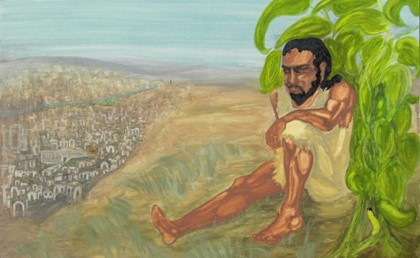
The Lord said, “Is it right for you to be angry?” And Jonah went out of the city and sat down to the east of the city and made a booth for himself there. He sat under it in the shade, waiting to see what would become of the city. The Lord God appointed a bush and made it come up over Jonah to give shade over his head, to save him from his discomfort, and Jonah was very happy about the bush. But when dawn came up the next day, God appointed a worm that attacked the bush, so that it withered. When the sun rose, God prepared a sultry east wind, and the sun beat down on the head of Jonah so that he was faint and asked that he might die. He said, “It is better for me to die than to live.”
But God said to Jonah, “Is it right for you to be angry about the bush?” And he said, “Yes, angry enough to die.” Then the Lord said, “You are concerned about the bush, for which you did not labor and which you did not grow; it came into being in a night and perished in a night. And should I not be concerned about Nineveh, that great city, in which there are more than 120,000 who do not know their right hand from their left, and also many animals?”
For the word of God in scripture, for the word of God among us, for the word of God within us, thanks be to God.
In the house that I grew up in, there was a picture. Now, some of you have heard this story before, but hang in there—there’s an update, okay? This picture was from the late ’80s or maybe early ’90s, and when people would come over, they would stand in front of it—maybe just for a few seconds, maybe for a few minutes—and then they would proclaim, “Oh, I see it!”
Now, the thing about this picture is that it was not a great work of art. It was not a beautiful photograph from a famous photographer. It was what is called a stereogram. How many of you remember stereograms? Those are those pixelated pictures in multiple colors that were designed in such a way that, when you looked at them for a while, suddenly a 3D image would appear. This particular stereogram was a conglomeration of blue and purple dots, and what would appear was an astronaut coming out of the back of a space shuttle. I have to take that on other people’s word because for all the time that I lived in that house, and the many, many minutes—hours, really—that I spent standing in front of that darn picture, I never once saw the space shuttle. And it was annoying because guests would come, and they would go and stand there, and then, “Oh, there it is!” But I never could see it.
I got all kinds of advice—“Don’t look too hard,” or, “You have to let your eyes relax.” My favorite was, “Don’t look at the picture; look through the picture.” None of this worked for me.
So, the update: a couple of years ago, my parents were getting ready to move, and we were cleaning out a closet. Out came my arch-nemesis, the stereogram, once again. I figured, you know what? I’ve grown. I’ve matured. I’ve gained wisdom and insight. I have multiple degrees. Surely now, when I look at this picture, I will be able to see the space shuttle. Nope. Still can’t see it. It’s okay, you can laugh.
Jonah couldn’t see the big picture. God calls him to go to Nineveh, a great city in Assyria, Israel’s arch-nemesis, and he doesn’t want to go. So he hops on a ship going in the opposite direction to Tarshish. But they run into trouble, and the crew figures out that they have someone on board who is fleeing the Lord. To save themselves, they throw Jonah overboard, where he’s swallowed by a large fish. He remains alive in the belly of the fish for three days until eventually, it swims him to shore and throws him up right there—on the shores of Nineveh, the very place he was trying to flee.
The word of the Lord comes a second time to Jonah: “Go out to the Ninevites and proclaim to them their sin.” Jonah walks to Nineveh, and you can just imagine how lackluster his prophecy is: “Forty days more, Nineveh shall be overthrown…whatever.” He’s not invested in this, let’s just say.
Now, as if all of that wasn’t enough, the most surprising and shocking turn of all is that—guess what?—the people actually listen to Jonah. Even the king drafts a decree for the Ninevites to immediately change their ways.
Now, do I need to tell you that this doesn’t happen? When was the last time you saw on social media two people disagreeing, and it was resolved with someone saying, “You know what? That was actually a really valid point. After this, I’m going to go home and reevaluate my whole worldview. Thank you very much.” It doesn’t happen, right? Except in the book of Jonah. The Ninevites all repent at the drop of a hat, and God changes course too. Instead of destroying them and their city, God has mercy on them, since they have repented.
And they all live happily ever after. Except for Jonah. Poor Jonah. Jonah is angry, mad because God had mercy on his enemies. And what’s worse is that God tricked Jonah into going to his enemies and proclaiming this mercy. He even says, “See, this is why I didn’t want to come here in the first place! I knew all along that you were a God who is gracious and merciful, slow to anger, abounding in steadfast love.”
This is the true dilemma that drives the book of Jonah. At first glance, we might think it’s about the Ninevites and their evil ways, or about their conversion. But it’s actually about Jonah. The person God is really after—the conversion God is after—is that of Jonah, not the Ninevites. And so, this question—“Is it right for Jonah to be angry at God because God showed mercy on the Ninevites?”—that’s the question driving this narrative.
The book of Jonah reminds us that we don’t control God’s mercy. God is free to show mercy to whomever God chooses. But, and this is the part I especially want to lift up today after the week we’ve had—where many of us are distressed and unsure, perhaps even looking for the next ship to Tarshish ourselves—it is significant that this story of Jonah being angry with God is in the Bible at all. This anger is part of the biblical narrative. Notice that Jonah is not struck down. He’s not chastised. God does not tell him how to feel. Rather, Jonah is invited into a conversation with the divine about his anger.
Anger, after all, is an emotion. And emotions are signals. They’re signals to us that something—maybe in us, maybe in our environment, but something—needs our attention. It’s a warning sign, a call for us to pay attention. For Jonah, he’s perhaps being called to pay attention to the gap between God’s mercy and his own. For you and me, it might be something different this week, or perhaps just a different version of that same gap.
In any case, what we can take away from this story is that anger is a valid emotion and can be a part of a faithful response. It’s okay to be angry. Now, where we might want to draw the line, though—and Jonah’s walking right on this line—is between anger and despair. Jonah says he’s not just angry; he’s angry enough to die.
Brené Brown helps us distinguish between anger and despair. She writes, “Despair is a claustrophobic feeling. It says nothing will ever change. It’s different from anger, sadness, or grief. Despair is tinged with hopelessness. People who subscribe to over-leadership often weaponize despair. They count on people giving up on themselves, on their work, and on each other.”
She continues, “The research shows that hope is a powerful antidote to despair. What’s interesting, however, is that hope is not an emotion; it’s a cognitive behavioral process. It’s about having a goal, a pathway to achieve that goal, and a sense of agency—or ‘I can do this.’” She says, right now, and you can tell when she’s writing this, “right now, the thing that is helping the most is micro-dosing hope. I have no access to big hope right now,” she says. “However, I’m asking myself, how can I support others around me, the people on my team in my community? How can I make sure that, in the maelstrom of my emotions, I stay committed to courage, kindness, and caring for others, regardless of the choices made by others?”
Friends, sometimes life just looks like a confusing array of dots, and we can’t make sense of it all. Times like these, Jonah comes in handy, reminding us that anger can indeed be part of a faithful response, but also a reminder that we need to guard against our anger turning to complacency or despair. Because in the end, anger is a very solid and valid emotion, but it’s a terrible strategy.
So friends, how do we guard against complacency and despair? And how do we eventually move to hope? Sorry to disappoint you, but I don’t have the answers. Remember, I can’t even make out that picture. But you know what? Reading Jonah again makes me think that maybe we’re closer than we might think. Because for Jonah, the point of his distress is also the point of his hope: “For I knew that you are a gracious and merciful God, slow to anger and abounding in steadfast love.”
May the God who loves us into loving be patient with us. And may we be patient with each other. And may we be patient with ourselves. And may our anger, once again, eventually, turn into hope. And may that hope, then, shape our actions—even when the big picture is still a mystery.
Amen.


