
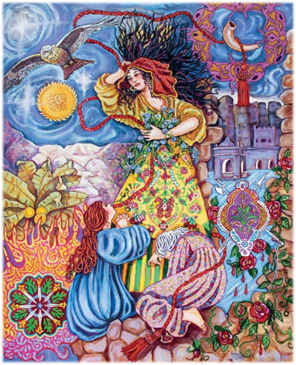
Sermon Transcript: December 8, 2024
Well, I would put today’s scripture reading up against the plot of any good spy novel or spy movie. It is from Joshua, chapter two, and it centers around a woman named Rahab. And Rahab is the next in our series that we’re doing here for Advent, Hidden Hope: The Women Who Paved the Way. These are all women who are mentioned in Jesus’ genealogy in the Gospel according to Matthew. And then we’re going back to the Hebrew Scriptures to explore their stories a little bit further.
I’m going to go ahead and put Rahab over here with the other matriarchs over here. And just a reminder that if later on in today’s service you want to come forward and light a candle in thanksgiving or remembrance of someone who’s paved the way for you, or in subsequent weeks, if you want to come and add a picture of someone to our display, you’re welcome to do that as well, as we honor all those who have and continue to pave the way for us.
Just a quick word about today’s scripture. This comes at the end of the time where the Hebrew people have been wandering in the desert, looking for the Promised Land. They are on the cusp of the Promised Land. Today’s story is kind of the story of a reconnaissance mission—of a couple of Israelites going into the city of Jericho to kind of assess the situation there before any further action is taken.
Joshua 2: 1-21
And Joshua, son of Nun, sent two men secretly from Shittim as spies, saying, “Go, view the land, especially Jericho.” So they went and entered the house of a prostitute who was named Rahab and spent the night there.
The king of Jericho was told, “Some Israelites have come here tonight to search out the land.” Then the king of Jericho sent orders to Rahab: “Bring out the men who have come to you, who entered your house, for they have come to search out the whole land.”
But the woman took the two men and hid them. And then she said, “True, the men came to me, but I did not know where they came from. And when it was time to close the gate at dark, the men went out. Where the men went, I do not know. Pursue them quickly, for you may overtake them.”
She had, however, brought them up to the roof and hidden them with the stalks of flax that she had laid out on the roof. So the men pursued them on the way to the Jordan as far as the fords. As soon as the pursuers had gone out, the gate was shut.
Before they went to sleep, she came up to them on the roof and said to the men, “I know that the Lord has given you the land, and that the dread of you has fallen on us, and that all the inhabitants of the land melt in fear before you. For we have heard how the Lord dried up the water of the Red Sea before you when you came out of Egypt, and what you did to the kings of the Amorites who were beyond the Jordan, to Sihon and Og, whom you utterly destroyed.
As soon as we heard it, our hearts melted, and there was no courage left in any of us because of you. The Lord your God is indeed God in heaven above and on earth below. Now then, since I have dealt kindly with you, swear to me by the Lord that you will, in turn, deal kindly with my family. Give me a sign of good faith that you will spare my father and mother, my brothers and sisters, and all who belong to them, and deliver our lives from death.”
The men said to her, “Our life for yours! If you do not tell this business of ours, then we will deal kindly and faithfully with you when the Lord gives us the land.”
Then she let them down by a rope through the window, for her house was on the outer side of the wall, and she resided within the wall itself. She said to them, “Go toward the hill country so that the pursuers may not come upon you. Hide yourselves there for three days until the pursuers have returned; then afterward, you may go your way.”
The men said to her, “We will be released from this oath that you have made us swear to if we invade the land and you do not tie this crimson cord in the window through which you let us down, and you do not gather into your house your father, mother, brothers, and all your family. If any of you go out into the street, they shall be responsible for their own death, and we shall be innocent.
But if a hand is laid upon any who are with you in the house, we shall bear the responsibility for their death. But if you tell this business of ours, then we shall be released from this oath you made us swear.”
She said, “According to your word, so be it.” She sent them away, and they departed. Then she tied the crimson cord in the window.
For the word of God in scripture,
For the word of God among us,
For the word of God within us.
Thanks be to God.
So, let me see how closely you were listening. What were the names of the two spies that Joshua sent? Anybody? I heard a couple people say, “They don’t say.” Right. They don’t say.
Okay, so what’s the name of the harlot whose house they visit? Rahab, right? Do you get how odd it is that, in this story, the Israelite men are not named or mentioned, but this foreign woman—a harlot—is named? It certainly would not have passed unnoticed to this story’s ancient audience that the woman is named, and the men are not.
And beyond that, who is Rahab? She’s not a queen or a princess or married to somebody rich and powerful. She’s nobody, really, right? In fact, she is so much of a nobody that no one can even imagine her being a threat. She operates with impunity.
And did you catch? Her house is literally in the city wall. Visitors can come and go from either side of the wall without being seen or having to pass through the guarded gates. She is there, and yet no one really notices her.
And yet, who is the first person that the spies visit? Now, besides the more obvious reasons, the spies visit Rahab precisely because she is there and yet no one notices her. She’s the perfect double agent. All of her clients share things with her and talk freely with her because she’s nobody.
But think about it. She is the hub of all kinds of information and all kinds of secrets. And finally, she has no loyalty to the leaders of the city and to their status quo. They’ve done her no favors, nor frankly—despite the way that she plays it, and this is my interpretation—does she have any reason to think that the Israelites will be any better. She butters them up, right?
But really, she’s a free agent here. She can play both sides and come out a winner either way. Rahab is smart. Rahab is savvy.
“How are we to understand this character who has so little power in any official sense,” asks Bobby Williamson, “but who seems to know more than anyone else among the people of Jericho or the people of Israel? How do we understand the faith, the moral compass, the courage of this lifelong sex worker? Does she change over the course of this story? Is this a paradigmatic conversion story, as most ancient interpreters read it? Or is it all more complicated than that?”
I think we’re too ready to read stories like this from an individual, moralistic standpoint. Is Rahab good or is she bad? Are the Israelites on God’s side, or is it the people of Jericho who are innocent? We’d like to think in terms of these binaries.
Some of us had the privilege, on Thursday evening, of hearing Rabbi Sharon Brous, who was part of the ICJS—Institute for Islamic, Christian, and Jewish Studies—their annual lecture series. She has a book out. She’s on the radio. If you ever get a chance to hear Rabbi Sharon Brous, I highly recommend it. If you hear her on the radio, in the car, pay attention.
She has a book out called The Amen Effect. And it was remarkable. It was a kind of free-flowing conversation. But toward the end, someone asked her the question that I think we were all dreading, to be quite honest. I mean, there were probably 300 people in this room—it’s in an old synagogue over by Druid Hill Park—and somebody, toward the end, asked her about the Israeli-Palestinian conflict.
And she said this—something like this. This is what I remember her saying: I refuse the binaries. I refuse to say this side is good, and the other is evil. She said, We can and must insist on a third way. Refuse to dehumanize those with whom we disagree.
And then she said this: Our hearts are big enough to care about the innocent children of Palestine and the Israelis being held hostage. She said, We will only get the world that we all want when we stop dehumanizing the other and recognize that every single one of us is made in the image of God.
The truth of the matter is, our world is full of Rahabs—people we just look past. They’re forgotten. They’re neglected. They’re kept down. And yes, they are dehumanized.
And let’s get one thing clear: this story is not about whether or not Rahab has let the world down, but how the world has let her down.
Her inclusion in God’s story and in Jesus’ genealogy is yet another reminder that God loves every single one of us. No one is disposable. No one deserves to be demonized. We are all part of God’s story. Nobody is a nobody.
Rahab also reminds us of that hidden hope that’s been there all along. We all have gifts and talents to contribute. We all have a role to play. And even the simplest act of kindness and courage can have a tremendous impact.
“As long as there are people,” writes Dietrich Bonhoeffer, “Christ will walk the earth as your neighbor, as the one through whom God calls you, speaks to you, makes demands of you. That is the great seriousness and great blessedness of the Advent message. Christ is standing at the door. He lives in the form of a human being moving among us.”
So my Advent challenge to you this week is to notice those who are often overlooked. But don’t just notice them. See them. Really see them. Talk to them if you’re able. Pray for them. And before you go to bed at night, be sure to thank God for meeting you in that person that day.
And remember this: You, too, are worthy of love. Not just worthy of love—you are loved. You are not insignificant. You are God’s own precious and beloved in God’s sight.
So find someone this week. Find someone this week who needs reminding of that truth—even if the person who needs to be seen is the one who’s looking back at you in the mirror.
Amen.


