
Sermon Transcript: December 15, 2024
Well, this is the third Sunday in our Advent series, Hidden Hope: The Women Who Paved the Way, where we have been looking at the four women, besides Mary, who are included in Jesus’ genealogy. Professor Mitzi Minor of Memphis Theological Seminary writes,
While including any women was unexpected, the inclusion of these particular women would have shocked many first-century folks. At least two were foreigners—Rahab and Ruth—and one was married to a foreigner. All four suffered as a direct result of the male-dominated rules and traditions of their time. All four were labeled as suspect in their day. To bring hope to their families, all four took actions—even aggressive actions—which women in their worlds were not supposed to do. So, they were the wrong kind of women in their day. But their supposedly wrong actions contributed to God’s purpose, despite their wrong nationalities. And Matthew includes them in the story of God’s work in the world to bring history to the moment when God’s renewal of all creation was launched in Jesus the Messiah.
Today, we hear the story of Ruth. She has been added to our prayer station over here. And just a reminder—there are actually a couple of other women who have been added, so you may want to come forward and take note of that. If you would like to come forward at any point in today’s service or after today’s service to light a candle in remembrance or thanksgiving of someone who paved the way in your life or who paved the way in our larger world, you are invited to do so.
And if you would like to add a picture, you are welcome to do that as well.
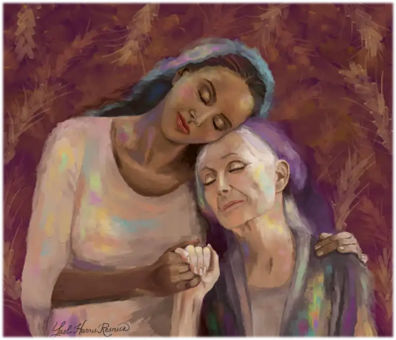
Ruth was a Moabite woman who marries into an Israelite family. The family had moved to Moab to flee a great famine. And after tragedy strikes, only the women—Naomi and her daughters-in-law, Ruth and Orpah—are left. Without husbands or sons, they must find a way where there is no way. Let us listen this morning to God’s Word for us from Ruth 1: 6-18, 22:
Naomi started to return with her daughters-in-law from the country of Moab, for she had heard in the country of Moab that the Lord had considered His people and given them food. So she set out from the place where she had been living, she and her two daughters-in-law, and they went on their way to go back to the land of Judah.
But Naomi said to her two daughters-in-law, “Go back, each of you, to your mother’s house. May the Lord deal kindly with you, as you have dealt with the dead and with me. The Lord grant that you may find security, each of you in the house of your husband.” Then she kissed them, and they wept aloud.
They said to her, “No, we will return with you to your people.”
But Naomi said again, “Turn back, my daughters. Why will you go with me? Do I still have sons in my womb that they may become your husbands? Turn back, my daughters, go your way, for I am too old to have a husband. Even if I thought there was hope for me, even if I should have a husband tonight and bear sons, would you then wait until they were grown? Would you then refrain from marrying? No, my daughters, it has been far more bitter for me than for you because the hand of the Lord has turned against me.”
Then they wept aloud. Orpah kissed her mother-in-law goodbye, but Ruth clung to her.
So she said, “Look, your sister-in-law has gone back to her people and to her gods. Return after your sister-in-law.”
But Ruth replied, “Do not press me to leave you or to turn back from following you! Where you go, I will go; where you lodge, I will lodge; your people shall be my people, and your God, my God. Where you die, I will die—there will I be buried. May the Lord do thus to me, and more as well, if even death parts me from you.”
When Naomi saw that she was determined to go with her, she said no more to her.
Naomi returned together with Ruth, the Moabite, her daughter-in-law, who came back with her from the country of Moab. They came to Bethlehem at the beginning of the barley harvest.
For the Word of God in Scripture,
for the Word of God among us,
for the Word of God within us:
Thanks be to God.
Well, I think the holiday stress has set in. Less than two weeks till Christmas! I’ve heard a lot of talk about the preparations and whether one feels ready or not quite so. There’s a lot of things left on the to-do list.
I have to admit that one of the most stressful parts of the holiday still lies ahead for me, and that is wrapping the presents. Let me just say this: it’s a very unfortunate thing when your gift-wrapping as a middle-aged man looks like it was done by a three-year-old. For whatever reason, this is not a skill I have ever acquired, and so I usually find others to help me with the task. (Shout out to my daughter Audrey!) I don’t know what it is that is stressful for you, but that is one of the things for me.
We don’t often think about it, but biblical stories come to us wrapped. Scribes, scholars, and editors have made choices in how it is presented to us. Of course, there’s the translation—these stories weren’t written in English. Translation always involves choices.
Also, chapters and verses were added. I don’t know if you know this, but when they were originally written, chapters and verses were not put in there. Later, scribes and editors added those for our reference.
And this one surprises people a lot, too. If you open up your Bible, a lot of times there will be subheadings. Those subheadings are not part of the original texts. Those were added, again, by editors to summarize what was to come and to help us locate it so that we can find the stories a little bit quicker.
The ancient people had these stories on scrolls. They would unfurl the scroll, and they would maybe know or have to spend time searching for the particular passage that they were looking for. But probably the ancient people didn’t look for chapter and verse like you and I might—they would read the whole story again.
Here’s another one that may be surprising to you, and it’s a pretty big one: the books themselves are not named. The authors didn’t give them names. Those names were later additions by scribes and editors to differentiate one book from another.
All this is to say that the first readers of our story today would not have known the scroll by the title, The Book of Ruth. That’s part of our wrapping, not theirs. Without that, they would most likely have assumed that the central figure—the main protagonist—is Naomi, not Ruth.
After all, Naomi is the matriarch. She is the Israelite. Hers is the plight with which the narrative seems most concerned.
On the other hand, Ruth is an unlikely heroine. She is a Moabite, which the narrator makes sure we know—at one point, even doubling down, calling her “Ruth the Moabite from Moab.” It’s just so we don’t miss the point that she is an outsider. She’s not one of us.
As the narrative progresses and the readers learn that it is Ruth and not Naomi that is the focus of the story, there would have been this sixth-sense revelation—especially at the end, when it is declared that Ruth, and not Naomi, is the great-grandmother of King David.
It is the outsider, the foreigner, the immigrant, the pagan, who is the focus of the narrative. And this twist is perhaps meant to subvert the readers’ expectations and expose their biases.
It is the very one that we would overlook who is the key to the whole story.
This past Thursday at Atwater’s—where I’m usually at for coffee on Thursday mornings, and where people sometimes join me—I was sitting there before my eventual guests arrived. I was sipping my coffee, trying to wake up, when a family sat down nearby. It was a mother with three little children, all under the age of five or six, having breakfast together. The kids all had pancakes, and the mother had a breakfast sandwich. I was trying not to be nosy, but I couldn’t help watching what was unfolding in front of me.
This mother tended to the needs of her children with so much care. She cut up all their pancakes. The middle one was trying to cut her own but wasn’t succeeding, and the mother let her struggle with it for a while before gently saying, “Here, let me help you.” The youngest—probably about one-and-a-half—wanted to pour her own syrup, saying, “Me do it!” The mother let her try, carefully guiding her hands. When a little syrup spilled, the mother patiently cleaned it up—no fuss, no big deal.
Then the children all noticed that the mother had bacon on her sandwich, and they decided they wanted bacon. Without hesitation, she took the bacon off her sandwich and split it up among the kids.
At the point when they were all settled, and she was finally about to take her first bite of breakfast, the middle child said, “I have to go potty.” And so, this very patient mother got everyone up—they’re all very small, in a very public place—and they all went to the bathroom together.
When they came back, the mother sat down and finally took a bite of her sandwich. Then the youngest said, “Mommy, I have to go potty now.” The mother, still calm, said, “We were just there.” The child insisted, “I have to go now.” So, the mother sighed slightly but said, “Okay, we’ll go in a minute,” and eventually, they all got up again.
What amazed me was that this mother remained calm, attentive, and kind throughout. On my best day as a parent, I’m not sure I could have done the same. I probably would have saved some of the bacon for myself. And if the youngest had wanted to go back to the bathroom after we’d just been there, I might have lost it a little bit.
And then—this is what really struck me as a sign from God—when they finished eating, the mother boxed up the leftovers and proceeded to bus their entire table. Now, Atwater’s has staff who will clean up for you, so most people don’t bother. But this mother made sure to leave the table spotless.
It hit me: if it weren’t for the happenstance of me sitting there, no one would have noticed any of this.
Politicians, CEOs, athletes, and movie stars—they all get our attention and our accolades. But there are everyday people, like this mother and like so many others, who quietly go about their lives, doing extraordinary things without recognition.
I wanted to let this mom know that I saw her, that as a fellow parent, I was so impressed with how she parented her children. I was looking for a chance to say, “Wow, you’re doing an amazing job.” But the opportunity didn’t come, and truthfully, I was worried it might come across as creepy. So instead, I just said it under my breath and marveled at what I had witnessed.
To be clear, this mother didn’t need my approval. She wasn’t doing any of this for recognition—she was simply doing what needed to be done for her children.
And so was Ruth. Ruth didn’t stay with Naomi for recognition. She didn’t do it for accolades or because someone would one day write a book about her. She did it because it was the right thing to do. She did it because that’s the way she would want to be treated if the roles were reversed.
Ruth refused to turn aside from someone who needed care and kindness, even though it would have been much easier to leave.
When we unwrap Ruth from all the packaging, we see the story of a simple woman—a foreigner with no power or privilege—showing us the very hospitality that we might deny her. She reminds us of those who have paved the way for us, many of whom go unnoticed and unappreciated.
Her inclusion in Jesus’ genealogy is a reminder that God counts on the Tamars, the Rahabs, the Ruths, the Bathshebas, and the Marys to bring love and justice into our world—not through kings, presidents, or billionaires, but through people like Ruth, the mother at that coffee shop, and countless others who never get the credit they deserve.
These are people who refuse to be limited by categories of nationality, religion, gender, or whatever else. Instead, they honor the dignity and humanity of the person in front of them, whether that person is family by birth, family by choice, or simply someone they find themselves sharing space within a moment of need.
To unwrap Ruth in Advent is to remember that God is like a patient mother, caring for us, nurturing us, letting us try things on our own, and quietly cleaning up our messes when we spill.
God is like a faithful daughter-in-law, refusing to let her mother-in-law be forgotten or left behind. God is like a companion who stays with us on the journey, even when the journey gets hard.
To unwrap Ruth in Advent is to remember the hidden hope that God wraps into our everyday lives. It is to remember that the greatest gift we can unwrap this Christmas is the gift of God’s love—alive and at work in the world, waiting to be found when we pay attention, always there even when we don’t, and as close to us as our own hands and hearts when they are open to our neighbors near and far.
Amen.


