
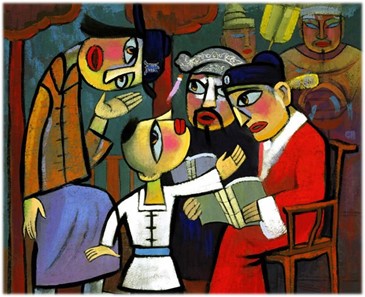
Sermon Transcript: January 5, 2025
So we begin this new year with a new journey in our narrative lectionary. We begin in the Gospel according to Luke. Luke is one of the so-called synoptic Gospels—synoptic just being a fancy word that means “seeing with one eye.” It refers to Matthew, Mark, and Luke, with John being the odd one out because, well, John just kind of plays by his own rules.
Through each of the Gospels, we hear of the life, death, and resurrection of Jesus of Nazareth. Each tells the story in its own way. With Matthew, Mark, and Luke, there are enough similarities that it is believed they share a common source. In fact, scholars are pretty sure that Matthew and Luke use Mark as their source. Mark is much shorter, and then each of the others puts their own spin on it.
Matthew is very interested in helping his Jewish contemporaries understand the story of Jesus within the larger Jewish narrative, while Luke is very interested in the perspective of the Gentiles. He refers to Jewish traditions, but he does so in a way that doesn’t assume his audience already knows what he’s talking about. He teaches about them as he goes.
Luke particularly focuses on the theme of inclusion—of outsiders being brought into the story through Jesus. Today, we read a very interesting story that hints at, and we’ll talk about this, a portion of Jesus’ life that we really don’t hear much about.
Here we are at the end of the Christmas season. Christmas is such a big deal in our culture and in the church now that we might not realize—or remember—that for the first 300-plus years, Christians didn’t celebrate Christmas at all. It wasn’t until much later that people went back and said, “We really don’t know a whole lot about Jesus’ birth, and we should celebrate that.”
The same goes for Jesus’ boyhood, his adolescence, his teen years, and even his early adulthood—really up until the beginning of his ministry. This story from Luke, following this theme of inclusion, touches on the gap we have in the life of Jesus.
From Luke 2: 41-52:
Now every year his parents, Jesus’ parents, went to Jerusalem for the festival of the Passover. When he was 12 years old, they went up as usual for the festival. When the festival was ended and they started to return, the boy Jesus stayed behind in Jerusalem, but his parents were unaware of this. Assuming that he was in the group of travelers, they went a day’s journey. Then they started to look for him among their relatives and friends. When they did not find him, they returned to Jerusalem to search for him. After three days, they found him in the temple, sitting among the teachers, listening to them and asking them questions. And all who heard him were amazed at his understanding and his answers. When his parents saw him, they were astonished, and his mother said to him, “Child, why have you treated us like this? Your father and I have been anxiously looking for you.” He said to them, “Why were you searching for me? Did you not know that I must be in my Father’s house?” But they did not understand what he said to them. Then he went down with them and came to Nazareth and was obedient to them. His mother treasured all these things in her heart.
And Jesus increased in wisdom and in years, and in divine and human favor.
For the word of God in scripture,
For the word of God among us,
For the word of God within us—
Thanks be to God.
So how do you experience the holy? Do you have to be alone or with others? Do you have to be somewhere special, or can it be anywhere? Are you doing certain things? Are there rituals? Or is it in the everydayness of life? Is it only when things are going your way? Or can you experience the holy even in the midst of disappointment, or when things are falling apart?
What about things like mischief?
Pilgrimages and rituals to experience the holy are part of many faith traditions. We see that today in our passage. Joseph and Mary travel to Jerusalem to participate in the festival of the Passover. The first-century historian Josephus tells us that there would have been about three million people in Jerusalem for the Passover. Now, I see some faces—three million? Really? Josephus was known for exaggerating. But even if he doubled the number, that’s still a lot of people. Jerusalem was smaller in square footage than Baltimore. Imagine all those tourists and travelers packed into this relatively small area for the festival.
It would have been very chaotic. Maybe that helps us understand how Mary and Joseph could have lost track of Jesus. Luke even gives them a bit of an out. They assumed he was with the traveling party. They weren’t traveling alone as just their little family, but with many relatives, friends, and people from their town. It probably wasn’t unusual for kids to wander off with friends, so they assumed, “He’s in the caravan somewhere. He’ll turn up.” Until a day later, when they realized—oh no—we left him behind. It’s kind of like that scene in Home Alone, where the mom’s on the plane and suddenly shouts, “Kevin! Oh no!”
It makes us wonder about Jesus as a boy. What was he like? Was this out of character for him? Did he wander off often? Did he get in trouble? Was he mischievous? Boys that age are often mischievous. I remember when my son was about that age, maybe a little younger. He had a friend over—his name was Gabriel. Let me tell you, this boy was no angel.
He wasn’t harmful, but he was mischievous in that way where you look away for one minute, and they’re up to something. I remember looking outside and seeing my shed door open. Then I saw Gabriel and my son walking back from behind the shed—with weed killer. Now, this was years ago—I don’t use weed killer anymore. But I thought, how did they get that? It was on a high shelf! I came out and said, “Excuse me, we don’t play with weed killer in this house.” Gabriel said, “Oh, Mr. Hanna, it’s okay! I was just taking care of the English ivy behind your shed.” When his dad picked him up, I said, “It was nice having him over!” His dad said, “Really? He doesn’t get invited for many second playdates.”
So what was Jesus like as a little boy?
There are apocryphal Gospels that include stories about Jesus as a child, like the Infancy Gospel of Thomas. These stories portray Jesus as very precocious. One story has him make pigeons out of clay and then bring them to life. Others tell less positive stories—striking down playmates, rebuffing teachers, even blinding neighbors. These stories mix divine power with the aptitude of a teenage boy. Nobody takes these stories as historical; they were ways the early church filled in gaps the Gospels left.
But it makes us wonder: did Jesus have this divine aptitude as a boy? And if so, what kind of chaos or mischief might he have gotten into? These musings might seem trivial, but they’re not inconsequential. As Marcus Borg suggests, how we understand who Jesus is shapes how we understand the nature of God. So if we wonder whether Jesus was mischievous, we might also wonder—could God, in some way, be mischievous?
Mischief can be negative or positive. It can be mean-spirited or fun-loving. It can also be ambiguous, like my son’s friend Gabriel. In the apocryphal Gospels, Jesus is sometimes portrayed as mean-spirited. But church tradition rejected those portrayals. Luke, on the other hand, shows Jesus as precocious, maybe even a little bratty when his parents find him in the temple.
This invites us to consider God in playful ways. Can the holy be found not just in worship or safety, but also in the playfulness of life? Can God’s playfulness push boundaries in ways that bring joy?
Another important aspect of this story is the community that surrounds Jesus. His parents assumed others were caring for him. That trust speaks volumes. Parents—imagine not seeing your child for a day but trusting they’re safe because of the people you’re with. Luke emphasizes that Jesus is not alone. He is surrounded by family, community, and traditions that care for him and help him grow.
When we come to this table, we do so as a community—not as individuals, but as individuals in relationship. We are one extended family. And yes, we include misfits, playful ones, and those who play it safe. Luke tells us this is how God enters the world—not as something other, but as one of us, fully one of us.
May this new year be a new opportunity to cherish the holy all around us, to see the holy in each of us, and maybe to cause some holy mischief.
Amen.


