
Sermon Transcript: June 8, 2025
Today is Pentecost, according to the church calendar. And so we will read the story of the first Pentecost from Acts chapter two. In addition, I will also be reading a portion of Galatians five, in which Paul talks about living by the Spirit.
Acts 2:1-4
When the day of Pentecost had come, they were all together in one place. And suddenly from heaven there came a sound like the rush of a violent wind, and it filled the entire house where they were sitting. Divided tongues, as of fire, appeared among them, and a tongue rested on each of them. All of them were filled with the Holy Spirit and began to speak in other languages, as the Spirit gave them ability.
Galatians 5:16-26
Live by the Spirit, I say, and do not gratify the desires of the flesh. For what the flesh desires is opposed to the Spirit, and what the Spirit desires is opposed to the flesh, for these are opposed to each other, to prevent you from doing what you want. But if you are led by the Spirit, you are not subject to the law. Now the works of the flesh are obvious: sexual immorality, impurity, debauchery, idolatry, sorcery, enmities, strife, jealousy, anger, quarrels, dissensions, factions, envy, drunkenness, carousing, and things like these. I am warning you, as I warned you before: those who do such things will not inherit the kingdom of God.
By contrast, the fruit of the Spirit is love, joy, peace, patience, kindness, generosity, faithfulness, gentleness, and self-control. There is no law against such things. And those who belong to Christ have crucified the flesh with its passions and desires. If we live by the Spirit, let us also be guided by the Spirit. Let us not become conceited, competing against one another, envying one another.
For the Word of God in Scripture,
For the Word of God among us,
For the Word of God within us,
Thanks be to God.
***
Pentecost is one of those days on the church calendar that makes me wonder why God does not show up as often now as God seems to show up in biblical times. I mean, you read the Bible, and God is all over the place—every page—talking to people through messengers, through prophets, through burning bushes, through the wind, fire, and even silence. God was in Jesus, speaking truth and showing love. But where is God now? And why is God not more apparent? Has God gone silent? Was God only active then?
Now, of course, we need to look at the sample size. The Bible was written over millennia. Even the relatively compressed timeline of the Christian scriptures is still probably 150 to 200 years. When we take that into consideration, maybe God wasn’t quite so all over the place in biblical times as it first seems.
Also, although scripture is written from the perspective of faith and belief, there sure is a lot of doubt in there. No one believed Abraham—that he talked to God—not even his wife. Everyone thought Noah was off his rocker when he was building the ark. The disciples were always second-guessing Jesus. And no one believed the women when they said the tomb was empty. They thought it was an idle tale.
But Pentecost seems different. It was a crowd of people gathered together, all experiencing the same thing at once. They were all gathered together in one place, and suddenly a rush of—violence?—a violent wind came upon them, and they began to speak in other languages. I mean, that sounds pretty undeniable, doesn’t it?
Except… where does it say that God was present?
If a rush of wind came among us now and blew the doors open—if some of us saw tongues of fire and reported being able to speak different languages—how would we describe what was happening? Would we use religious language? Or would we talk about it in paranormal terms? What we experience and how we describe it largely has to do with what we expect—and what language we have available to us at the time.
It is said that history is written by the winners. An analogous statement might be: Scripture is written by believers. It’s meant to convince us to believe as well. But the truth is, in terms of faith, there is no proof for the unbelievers. Whether or not we are inclined to have faith has to do with our own experiences and disposition. There’s an old saying: “No explanation is needed for a believer, and no explanation suffices for an unbeliever.” Another way to say all of this is that faith is a lens through which we can choose to look at the world.
And the truth is that we’re not either a believer or an unbeliever. Most of us are somewhere on the spectrum in between the two. People of profound faith can have deep and abiding doubts. Let me say that again: People of profound faith can have deep and abiding doubts. Because faith is never about certainty. It’s about that ability to hope and trust in the midst of uncertainty. If we take all the uncertainty away, it’s not faith anymore.
When we choose to look through the lens of faith, it just may be that God suddenly starts showing up everywhere. Not always in a way that’s easy to pinpoint, but more so a sense of mystery and awe at even the most ordinary of things. A rain shower. A clear night sky. The knowing smile of a partner or a friend. The kind words of a stranger. And even sometimes—not always, for sure—but sometimes, in our own pain and suffering. Even the very absence and silence of God can themselves become holy vessels.
It’s hard to know what we would have seen or heard or experienced were we there on that first Pentecost. But according to Paul, we can choose to live by the Spirit even today.
Living by the Spirit is choosing the lens of faith. And it not only impacts the way we understand and interpret things that happen to us or that we experience—it impacts the way we choose to live and act.
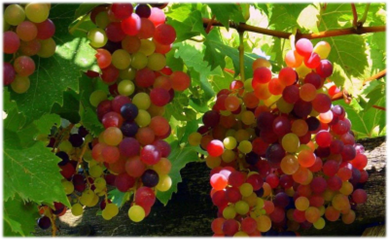
Paul puts it this way: the Spirit produces fruit in us. And the fruit of the Spirit are love, joy, peace, patience, kindness, generosity, faithfulness, gentleness, and self-control.
See how that just rolled off my tongue?
When I was in Sunday School, I had to memorize the fruits of the Spirit. Now, as an adult, I’m not a huge proponent of memorizing Scripture. To be sure, I’m not against it if you are so inclined. But not everyone is good at memorizing. However, the older I get, the more and more I value being familiar with Scripture—of having a few passages that you know so well that they can just come to mind. Classic examples of these are the 23rd Psalm and the Lord’s Prayer, right? But there are others that may speak to you.
For me, Psalm 139 has always been a balm for my soul. “You are fearfully and wonderfully made,” the psalmist says. “I know you so well—even in your mother’s womb.” I can’t say the whole psalm by heart, but I know it. And it comes to mind for me at particular times. Or Isaiah 43: “When you walk through the waters, they will not overwhelm you.” That gives me courage and strength in times of trial. And Romans 12: “Let your love be genuine,” reminds me and challenges me to live better and to treat others more justly and kindly. I don’t have all of these memorized, but I know them. They’ve sunk into my soul, into my being. And they remind me of who and whose I am.
As I mentioned during the announcements, this past week I was with a group of Baltimore clergy—priests, rabbis, pastors, bishops, imams—and we each had a chance to talk about Pentecost and the Jewish and Islamic counterparts, and what our observation of these holy days might mean for us, for our congregations, and for our city.
The meeting was in preparation for the BUILD Citywide Action that is to take place this afternoon. So today, some 600 of us will gather in one place—from all over the city, from different cultures, different religious traditions. And it seems to me that God shows up… when we show up expecting God to show up. You can believe God chooses when to intervene in human events and history. Or you can believe, as the great Carl Jung once famously said: “Bidden or not, God is present.”
I want to end with… a gripe with Paul. Paul likes his dichotomies. He likes pitting things against each other—Spirit and flesh. He goes on and on about it. But you know, we like ours too: believer and unbeliever. Present, absent. But maybe the truth isn’t a dichotomy. Maybe it’s not an either/or. Maybe these seeming opposites are not separate realities but rather two sides of the same coin. You can’t have one without the other.
If we only pay attention to the Spirit but not the flesh, then we don’t care about the living circumstances of people in our city and in our nation and in our world. We don’t care about their bodies. That doesn’t sound very Christian to me.
But if they’re two sides of the same coin, then to pay attention to the Spirit reminds us of the holiness of the flesh—and the sacredness of each and every person.
So I submit to you: to live by the Spirit is not to neglect the things of the flesh and the things of this world. It is to come to the realization that they are fused with the divine, and that even God’s absence and God’s presence are part of the same mystery in which we live and move and have our being.
Amen.


