
Scripture: Genesis 9:8–17
So often when we read the Bible, familiarity is actually not our friend. It provides a challenge. That’s especially true with stories like Noah and the ark, which many of us have heard since we were little. It may be one of the first Bible stories that was ever read to us, maybe in a nice children’s book with wonderful pictures. But that familiarity can turn us deaf to new insights and to being willing and open to being surprised by the text.
That’s one of the reasons I’ve spread this reading over the past two Sundays. Last week we read about the flood and the building of the ark. Today we’ll read about the conclusion and the sign that is put in the sky.
After all these years of reading and studying this text, I was surprised this week. A commentator suggested that when God says in this passage—and we’ll hear this in today’s reading—“I have put my bow in the sky,” the reference is to a bow and arrow. I tested this with the adult ed group because I didn’t want to expose my ignorance if I was the only one. I had never thought of that before. Maybe you have. Good for you. But that was a new insight to me.
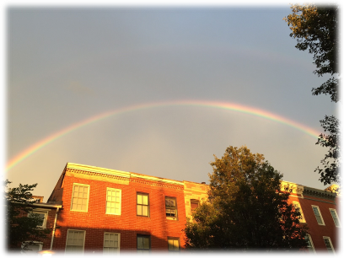
So the sign is not only there to remind us when we see a rainbow in the sky. It was also a symbolic act on God’s part in the story: to hang up the weapon. “I will no longer use this weapon. I will no longer use any weapons against you. We will resolve our differences peacefully and in other ways,” God is saying.
With that, I’ll turn us to the text and ask us to try, as best we’re able, to put on new ears and new eyes and new thinking, and be open to the new insights this text may have for us today.
Genesis 9:8-17
Then God said to Noah and to his sons with him, “As for me, I am establishing my covenant with you and your descendants after you and with every living creature that is with you, the birds, the domestic animals, and every animal of the earth with you, as many as came out of the ark. I establish my covenant with you, that never again shall all flesh be cut off by the waters of a flood, and never again shall there be a flood to destroy the earth.” God said, “This is the sign of the covenant that I make between me and you and every living creature that is with you, for all future generations: I have set my bow in the clouds, and it shall be a sign of the covenant between me and the earth. When I bring clouds over the earth and the bow is seen in the clouds, I will remember my covenant that is between me and you and every living creature of all flesh, and the waters shall never again become a flood to destroy all flesh. When the bow is in the clouds, I will see it and remember the everlasting covenant between God and every living creature of all flesh that is on the earth.” God said to Noah, “This is the sign of the covenant that I have established between me and all flesh that is on the earth.”
For the word of God in Scripture,
for the word of God among us,
for the word of God within us.
Thanks be to God.
***
Why is the sky blue and the grass green? Where does the sun go each night, and where do the stars go during the day? And what about those stars? Are they like lanterns hanging in the sky? Or are they holes in the fabric of the sky that let light through from whatever is on the other side?
Why do rainbows come out after rainstorms? Why are there floods and earthquakes? In the ancient world, it was common to tell stories explaining the way things are. If you want to impress somebody at a dinner party, these are called teleological stories. Telos is the Greek word meaning “ending.” The idea is that they are stories told with an ending already in mind. They explain the way things came into being.
Before science, this is how people explained the world around them: through stories. This is the way wisdom and learning were passed from generation to generation. Now, as modern people, we too often dismiss these stories as fairy tales or myths, by which we mean they’re cute, sometimes fun and insightful, but aren’t really meant to be taken seriously. They’re not true vessels of truth.
But as John Dominic Crossan once pointed out, it’s not that those ancient people told literal stories and you and I are now smart enough to take them symbolically. They told them symbolically, and sometimes you and I are dumb enough to take them literally.
Noah and the ark is no different. Many of us learned the story of the flood as children. I honestly don’t know what about God destroying the earth with a flood says, “This is a good child’s nighttime story.” But I guess the picture of animals going two by two is too cute to ignore. Some illustrator somewhere said, “I can draw that.”
The reality—we don’t need to imagine too hard—would have been anything but cute: smelly, hot, dangerous, noisy. Not fluffy, adorable, or fun. And the meaning has a lot more to do with us than the origin of rainbows and floods. It speaks to us of the relationship between the Creator and creation.
Walter Brueggemann explains: We do not have before us in the story of Noah and the ark a history. This story is not concerned with historical data. And with equal firmness, we must deny that this story is merely a myth. What meets us here, he writes, is proclamation: the announcement of what God has done and is doing about a fractured world.
Scholars point out that there were a lot of flood stories already floating around—excuse the pun—in ancient times. Biblical authors were no doubt aware of these other flood stories, which usually featured people doing something wrong to displease the gods and the gods sending a flood to punish the people. Sounds familiar, right? But instead of just telling that story, the biblical authors make it a proclamation about how the God of Israel is different from the gods of the nations.
Those gods carry their bows and arrows and swords around with them. The God of Israel doesn’t just punish people when they do wrong. God does care about justice, but God balances God’s justice, punishment, and judgment with love and mercy and forgiveness. The two are never apart. We never meet one without the other.
This is how the God of Israel is set apart. The Lord, the God of hosts, the God of Israel, the God of Abraham and Isaac and Jacob, no longer carries a weapon of violence. God has hung the bow in the sky, put it aside. “I don’t need it anymore.”
And yet God cannot allow wickedness just to pass by unnoticed or unchecked. God has to do something about it. Yet God does not leave humanity without recourse. God selects Noah and his family to build an ark and save just enough of creation to begin again.
Here we learn that God is the God of second chances. That’s where we left off last week. We’re reminding ourselves that despite what we first might think, or what we might have been taught, or how we learned the story originally, this is a story of grace and gratitude after all.
But the familiarity of this story is so strong. We’ve been carrying it with us for so long, along with a version of God that is harsh. We’ve been carrying these with us for far too long. It feels odd; it feels hard to read a story like this and find the God of second chances, and to know where we are in it.
Today I want to offer us another way into this passage that might help us find new relevance in this ancient story. This week I learned another thing. I learned two things this week, not just about the bow. I learned something else I want to share with you: in many Jewish communities, they have a different way of reading this story that makes it relevant for people of faith.
It’s obvious, right? We don’t need to build an ark. We have a much better understanding of meteorological events. We know floods aren’t sent by the gods. We can’t always predict flooding, but we know why it happens. We know why the sky is blue and the grass is green. We might not be able to explain it immediately to our children when they ask, but in general we know. We know why the sun sets, what the stars are—all these things.
So this isn’t just another teleological story. It isn’t history, it isn’t myth, it isn’t a fairy tale. It’s a proclamation. And the proclamation is this:
God knows that sometimes we need a vessel to get us to the other side of the storm. That’s why God had Noah build the ark: to protect him and his family, to help them weather the storm, to get through the flood. Perhaps not coincidentally, the word for “ark” in Hebrew is the same word for “word.”
And words are the vessels that we have to understand and reach out to God: the words of our lips, the words of our minds, the words of our hearts and spirits. In other words, our prayers. And in the Jewish community, that’s how they read this story. It’s about prayer. Prayer is the vessel.
According to Amy Robertson of the BibleWorm podcast, the Jewish tradition really digs into this. She says, “What does it mean to construct a word, a prayer life, a vessel that carries us through really difficult situations and helps us to keep somewhat apart from the wickedness that is all around us? How do we build a prayer that has an active life?”
Remember back to the instructions: God said not only all the cubits and all of that, but it has to have a window. How does our prayer life have a window in it so it’s not cut off from the realities of the real world, the outside world? How do we invite all of nature in, like Noah did—all of creation—so that we don’t imagine it’s just us and God sitting there, but we imagine ourselves sitting there in the midst of creation, surrounded by all of God’s creatures, knowing ourselves a part, not apart?
I love this interpretation. I’ve never heard that one before. I am grateful to our Jewish brothers and sisters and for their tradition for presenting that to us. It’s helped me move beyond all those little parts of my head—no matter how much I tell myself that this is proclamation—that try to reconcile this story to history or dismiss it as a fairy tale. It reminds us that God will not leave us without a vessel in a stormy world, a space for shelter and safety, a space to reflect.
So what I want to suggest is that this fall, as we begin this new program year together, we think of ourselves as an ark: this place, this community, the people gathered here to worship week after week. This is our ark. But God has some requirements. We don’t just get to build it to our own comfort and specifications. God has taught us how to build it, right?
It has to have a window in it. Our worship needs to be about more than us and the people here. It needs to have a window; it needs to be checked against the realities of the world. We need to always have one eye on the outside world. We cannot come here and turn our eyes from the suffering of others while we count our blessings.
Also, like Noah, we too must provide shelter and protection for all of God’s creatures, indeed all of creation. “Everyone is welcome here,” we say. Do we really mean it? Who is just outside of our doors looking for a vessel? Who has not been invited into our ark? And who needs to come with them?
I encourage us to think of this place as our ark, our vessel—not just the building, but our whole community. Because the truth is, our world is underwater: floods of violence and war, floods of animosity, floods of greed and injustice, storms of racism and sexism and religious bigotry. So many of us are drowning as well. We’re drowning in family entanglements, we’re drowning in our own issues, we’re drowning financially, we’re drowning in our jobs. We need shelter. We need an ark. We need a vessel to carry us through the storm to the other side.
We all know what it is to need an ark. I guess that’s why most of us are here. Because it’s all too much, and we need a break, a place to come, people to know us and help us keep our heads just above water. But this ark isn’t just for us, friends. It’s for others as well.
As we think about the image and the road ahead, as individuals and as a congregation, I want us to close today with a prayer inspired by the story of Noah and the ark. It was written by Rabbi Harold Kushner. You might recognize the name; he’s the author of When Bad Things Happen to Good People. Part of the prayer is on your bulletin cover. If you search for it, you can find the whole thing later. I would suggest that this prayer is kind of an ark for us, a vessel to guide us in the days and weeks and months, and maybe even years, ahead.
Prayer for the World
by Rabbi Harold Kushner
Let the rain come and wash away the ancient grudges, the bitter hatreds held and nurtured over generations.
Let the rain wash away the memory of the hurt, the neglect.
Then let the sun come out and fill the sky with rainbows.
Let the warmth of the sun heal us wherever we are broken.
Let it burn away the fog so that we can see each other clearly.
So that we can see beyond labels, beyond accents, gender or skin color.
Let the warmth and brightness of the sun melt our selfishness.
So that we can share the joys and feel the sorrows of our neighbors.
And let the light of the sun be so strong that we will see all people as our neighbors.
Let the earth, nourished by rain, bring forth flowers to surround us with beauty.
And let the mountains teach our hearts to reach upward to heaven.
Amen.


