
Sermon Transcript: October 6, 2024
So last week we moved on from Genesis to the second book of the Bible, the book of Exodus, and we are taking another giant leap today in the book of Exodus itself, but I wanted to just kind of give us a little bit of context for where we are. The book of Exodus gets its name, of course, from the initial Exodus experience, the Exodus event where God calls to Moses and helps Moses lead the Hebrew people to freedom from slavery in Egypt.
You’ll remember that they wander in the wilderness for 40 years. During this time, they learn to trust in God for their daily sustenance, their daily manna. Then they arrive in the Promised Land. Just when we expect everything to be hunky-dory and everything to go well, things fall apart — that’s what we’re going read about a little bit today. And the people get anxious, and they make other gods, and they forget the God that has freed them from slavery in Egypt.
And so there is this kind of repeated pattern that is set up that repeats itself throughout the book of Exodus, but also throughout all of Scripture, that I really want us to notice, and that is the cycle of liberation to formation to restoration. From liberation, God liberates us; formation, God forms us; and then the part that we skip over is we mess up somehow, right? And then God restores us. So, liberation, formation, and restoration.
Our reading today from Exodus 32: 1-14:
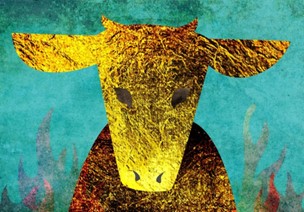
“When the people saw that Moses was delayed to come down from the mountain, the people gathered around Aaron and said to him, ‘Come, make gods for us who shall go before us. As for this Moses, the man who brought us up out of the land of Egypt, we do not know what has become of him.’ Aaron said to them, ‘Take off the gold rings that are on the ears of your wives, your sons, and your daughters, and bring them to me.’ So all the people took off the gold rings from their ears and brought them to Aaron. He took these from them, formed them in a mold, and cast an image of a calf; and they said, ‘These are your gods, O Israel, who brought you up out of the land of Egypt.’ When Aaron saw this, he built an altar before it, and Aaron made a proclamation and said, ‘Tomorrow shall be a festival to the Lord.’ They rose early the next day, and offered burnt offerings and brought sacrifices of well-being. And the people sat down to eat and drink, and rose up to revel.
Meanwhile, the Lord said to Moses, ‘Go down at once! Your people, whom you brought up out of the land of Egypt, have acted perversely. They have been quick to turn aside from the way that I commanded them. They have cast for themselves an image of a calf, and have worshiped it, and sacrificed to it, and said, “These are your gods, O Israel, who brought you up out of the land of Egypt.”‘ The Lord said to Moses, ‘I have seen this people, how stiff-necked they are. Now let me alone, so that my wrath may burn hot against them and I may consume them; and of you, I will make a great nation.’
But Moses implored the Lord his God and said, ‘O Lord, why does your wrath burn hot against your people, whom you brought out of the land of Egypt with great power and with a mighty hand? Why should the Egyptians say, “It was with evil intent that he brought them out to kill them in the mountains and to consume them from the face of the earth”? Turn from your fierce wrath, change your mind, and do not bring disaster on your people.
Remember Abraham, Isaac, and Israel, your servants, how you swore to them by your own self, saying to them, “I will multiply your descendants like the stars of heaven, and all this land that I have promised I will give to your descendants, and they shall inherit it forever.”‘ And the Lord changed His mind about the disaster that He planned to bring on His people.”
For the Word of God among us, for the Word of God within us, thanks be to God.
If last week’s message was about remembering—remember all the rituals with Passover that remind us of this God that we worship and that has done so much for us—if last week was about remembering, today is about forgetting. If last week was about liberation from external bondage, today is about the ways that we end up binding ourselves anyways.
When I was growing up, playgrounds were very different than they are now. They didn’t have soft mulch to cushion the fall. The floors were made of concrete. And we had all these dangerous contraptions. Like, I remember being on a McDonald’s playground where there was this little thing, and you would climb up into this little jail.
Or the merry-go-round. How many of you remember the merry-go-round? Yeah. I don’t know why they called it a merry-go-round. I think it should have been called “terrifying wheel of danger” or something more accurate. I mean, look, it could be perfectly a lovely ride, but the problem was that other kids were in charge of how fast it went. And every time I went on, these thrill-seeking kids, mostly boys, would play this game to see how fast they could go before people would start flying off the wheel. And the more that you screamed that you wanted to get off or that you were going to barf, the more fun they had and the faster they made it go. Now, for some odd reason, these medieval torture devices were banned in the late 80s or early 90s. I don’t know why.
But even as an adult, that feeling is still familiar, isn’t it? Not on the playground, but in everyday life. That feeling of going faster and faster and faster and not being able to get off.
German sociologist Hartmut Rosa calls this phenomenon social acceleration. And Charles Taylor describes it this way: it is the tendency built into our globalized capitalist economy. Globalization permits us to make and sell products more cheaply, and thus to create more consumers. But to pull this off, we have to make huge investments in transport—containers, ships, ports. Otherwise, our economies will grind to a halt, as we saw during the pandemic with the supply chain crisis, or even just recently with the threat of the strike.
In all these ways, growth impels more and more growth. There are systematic mechanisms at work here, Taylor explains, and we haven’t even begun to consider the subjective side—how mass production can tempt us to possess more and how cheap air travel can induce us to take holidays in exotic places that were once out of reach for us. Greater opportunities tempt us to do more things, travel more places, and undertake more tasks, and we find ourselves chronically short of time, overcommitted, and striving to keep pace to catch up. To-do lists lengthen beyond any possible fulfillment of the tasks they enumerate. In other words, we are on a merry-go-round that’s going faster and faster and faster.
Now, let me be very clear. Not all of these things are bad. No one’s saying that. The ability to travel and see the world is a wonderful, wonderful blessing. And technological progress creates safer cars, better medical equipment, and so on. These are undoubtedly good things. But it is the system that is crushing us. It is when growth and innovation are not byproducts of the system but absolutely necessary ingredients without which the whole thing would fall apart.
Just think for a moment of what most of us have in our pockets. Would Apple ever say, “Our next version is the last one. We can’t improve the camera anymore. There are no more gadgets we can add”? The moment they would do that is the moment they would begin to fail.
It’s this all-too-human tendency to confuse the means with the ends that is behind our story today of the golden calf in Exodus. We think we have nothing in common with these ancient foolish people who would mold for themselves a golden calf. But maybe we have more in common with them than we would like to believe. God has led the people out of bondage in Egypt. God has sustained them through the wilderness. God has brought them into a land flowing with milk and honey. God has given them a law to live in harmony and community with one another. And Moses goes up the mountain for just a little bit, and they don’t know what to do with themselves. They grow impatient and anxious. They want the merry-go-round to go faster and faster, and so they fashion idols of gold to worship.
And it’s not God’s jealousy that is the real issue in idol worship, although there is that really interesting exchange where Moses convinces God to remember His relationship to Abraham and to Isaac and to Jacob. No, what’s at issue is that you and I so quickly forget that we are free. And instead of some outside force binding us, we bind ourselves. Though free, we enslave ourselves to that which does not ultimately satisfy, that which does not ultimately care for us in return.
And the pattern repeats—liberation, formation, restoration. You see, God is ever saving us from ourselves. God is always restoring us to true freedom. God is always giving us a way off the merry-go-round, or as I prefer, the “terrifying wheel of danger.”
By the way, it’s a telltale sign that we are on the merry-go-round when we notice that even our relationships become transactional—when others become not individuals in their own right but commodities. When even our relationship to God is thought of in transactional terms.
We may not worship golden calves per se, but we do have our own idols, don’t we?
So thanks be to God that in the middle of our sanctuary is not a big merry-go-round, right? That is not the primary symbol of our faith, but a table—a table where we sit together, where we have all the time in the world to talk and get to know each other, where we are all guests, where no one is in charge but the host alone. Where finally we remember who and whose we are.
So I invite us, let’s get off the merry-go-round, and let us join together at the table. Let us be fed not by our own hands but by the gracious hand of our God, who wants nothing more than just to be with us and to love us into loving.
Amen.


