
Sermon Transcript: August 30, 2026
Mark 14:32–42
They went to a place called Gethsemane, and he said to his disciples, “Sit here while I pray.” He took with him Peter and James and John and began to be distressed and agitated. And he said to them, “My soul is deeply grieved, even to death; remain here, and keep awake.” And going a little farther, he threw himself on the ground and prayed that, if it were possible, the hour might pass from him. He said, “Abba, Father, for you all things are possible; remove this cup from me, yet not what I want but what you want.” He came and found them sleeping, and he said to Peter, “Simon, are you asleep? Could you not keep awake one hour? Keep awake and pray that you may not come into the time of trial; the spirit indeed is willing, but the flesh is weak.” And again he went away and prayed, saying the same words. And once more he came and found them sleeping, for their eyes were very heavy, and they did not know what to say to him. He came a third time and said to them, “Are you still sleeping and taking your rest? Enough! The hour has come; the Son of Man is betrayed into the hands of sinners. Get up, let us be going. Look, my betrayer is at hand.”
For the Word of God in scripture,
For the Word of God among us,
For the Word of God within us,
Thanks be to God.
***
Well, depending on your perspective, the words that I am about to say may make you a little sad or may make you very happy. This is the last in our sermon series on disputing with God.
Mixed reaction. Just what I expected.
But it’s been a fun journey this summer, so thank you for joining me on it.
Our last Scripture in this series comes to us from Mark, chapter 14. It is a familiar passage, although it is not one that we are used to hearing at this time of year.
From the Gospel according to Mark, chapter 14, verses 32 through 42:
They went to a place called Gethsemane, and Jesus said to his disciples, “Sit here while I pray.”
He took with him Peter and James and John and began to be distressed and agitated. And Jesus said to them, “My soul is deeply grieved, even to death. Remain here and keep awake.”
And going a little farther, he threw himself on the ground and prayed that, if it were possible, the hour might pass from him. He said, “Abba, Father, for you all things are possible. Remove this cup from me; yet, not what I want, but what you want.”
Then Jesus came and found the disciples sleeping, and he said to Peter, “Simon, are you asleep? Could you not keep awake even one hour? Keep awake and pray that you may not come into the time of trial. The spirit indeed is willing, but the flesh is weak.”
And again he went away and prayed, saying the same words. And once more he came and found them sleeping, for their eyes were very heavy, and they did not know what to say to him.
He came a third time and said to them, “Are you still sleeping and taking your rest? Enough! The hour has come. The Son of Man is betrayed into the hands of sinners. Get up, let us be going. See, my betrayer is at hand.”
For the Word of God in Scripture, for the Word of God among us, for the Word of God within us.
Thanks be to God.
Well, as I said, it’s a familiar scene, though we’re used to hearing this in the springtime, toward the end of Lent or maybe during Holy Week: Jesus in the Garden of Gethsemane, praying for God to “remove this cup from me,” by which he means his impending crucifixion.
Then there are his disciples, who aren’t even able to stay awake through the night with him. We find Jesus finally, at the end, submitting himself to God’s will, and then the betrayer leading the Romans right to him.
The scene is familiar, but what does it all mean? How does it apply to us? What are we supposed to take from all of this? And finally, how does it fit into our disputing with God series?
Let’s take a minute and review where we have been this summer in this sermon series.
Abraham, Moses, Jonah, the psalmist, the Syrophoenician woman—they all took issue with God in one way or another. At times, as with Moses and Abraham, the issue is something that God is planning on doing, namely punishing the people.
In the case of Moses, he convinces God not to punish the people for their idolatry. Abraham pleads with God to spare the people of Sodom, whose great sin was inhospitality to strangers.
Then there was God, who wanted Jonah to go to the Ninevites and warn the people that God would not tolerate their wicked ways. But Jonah doesn’t want to go because the Ninevites are his sworn enemy.
Then we had the psalmist, who was crying out in anguish and pleading with God to be present, and yet God seemingly remained silent and absent.
Last week, we read about this foreign woman, Canaanite or Syrophoenician, who begs Jesus to heal her daughter. Yet Jesus ignores her until she annoys him so much that he’s forced to answer.
In all of this, we’ve learned that Scripture is not naive about the struggles we face in life and how much you and I can wrestle with our faith.
Many of us were taught, or simply picked up along the way, that disputing with God is a no-no. It’s not befitting a faithful Christian. Yet here we have example after example in Scripture of people—not just any people, but pillars of the faith—doing just that.
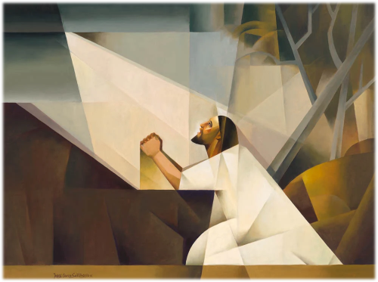
In today’s passage, it seems to be Jesus himself who is taking issue with God’s plan. He’s in the Garden of Gethsemane. His arrest, trial and crucifixion are imminent, and he goes there at night to pray.
He brings a couple of close friends with him and asks them only one thing: “Stay awake with me while I face this hour.”
But they can’t do even that.
Jesus prays to God, “Please, Lord, there must be another way. Take this cup from me. Yet, not my will, but yours be done.”
Then Jesus chides his disciples for falling asleep. He’s told them that his soul is deeply grieved, and he’s only asked them this one thing.
But they’re tired, and it’s dark and quiet there in the garden. We can imagine the noises of the wind going through the trees, and the animals and the crickets lulling them off to sleep.
When Jesus sees this, he’s upset. But then he thinks about it for a minute and says, “The spirit is willing, but the flesh is weak.”
We assume we know what he means: that they just don’t have the spiritual strength to face this trial with Jesus.
But I want us to consider this. I want us to ask this: What if, instead of merely chiding his friends and disciples for not staying awake with him, Jesus is reflecting on something deeper—a more profound truth?
You see, in ancient Greek, the language in which this story was written, they don’t have any way of distinguishing between capital letters and lowercase letters. There’s no capitalization in ancient Greek.
So there’s no way for us to know whether the Gospel writer Mark intended to write spirit with a small “s” or Spirit with a big “S.”
What does that matter?
Simply put, we don’t know whether Jesus is referring to their all-too-human spirit or whether he is intending to invoke the Holy Spirit.
As I said, you and I tend to read this as spirit with a small “s,” meaning that they want to stay awake, but they just can’t.
We can all relate to that, right? We’ve had some time or another when we’ve had to try to stay awake, but our eyes get so heavy and we just find ourselves drifting off. I don’t know—maybe it was during some sermon or something.
But what if Jesus isn’t referring to spirit with a small “s,” but God’s Spirit?
What if he is saying that, on their own, they can’t stay awake, but God’s Spirit is available to them to help them in their weakness?
As Paul would later write in Romans 8, “The Spirit helps us in our weakness, for we do not know how to pray as we ought, but that very Spirit intercedes with sighs too deep for words.”
It’s odd that so much could ride on something so simple. Is it a capital “S” or a lowercase “s”?
It reminds me of those grammar books that have become popular over the past 10 or 15 years. One of my favorites was Let’s Eat, Grandma, which made the point that if you remove the comma, you may go from a nice invitation to have dinner with your grandmother to cannibalism.
Sometimes small things make a big difference, right?
In this case, if we think Jesus is referring to spirit with a small “s,” then these poor disciples are left to their own devices in their time of need. But if we think Jesus is referring to Spirit with a capital “S,” then God is there with them, offering to help them through their time of want and need.
You’ll not be surprised that I would argue that the capital “S” is the way to go here. We need look no further than Jesus himself to back this up.
Jesus is facing his own dark night of the soul. He loves his friends. He doesn’t want to leave them. Yet his mission and his ministry have brought him into conflict with the Romans, and the consequences of that are fatal.
It has been said that Jesus is both a window into divinity and a mirror to our humanity. So it’s important for us to recognize that there may be no more human moment for Jesus than when he is praying in the garden.
He is honest with God: “I don’t want to die. I don’t want to be crucified.”
And yet he prays, “Not my will, but yours be done.”
You know, we can only truly pray that prayer when we know that God is on our side.
Too often, you and I think of God as an opponent of some kind—like God has nothing better to do than watch us all day long, just waiting for us to mess up so that we can be punished.
I would argue this is actually the predominant picture of God that many of us carry with us.
I’m sure that, at some point in human history, this was a really convenient theology. I can see what value that would have in keeping society in check. This is what led Karl Marx to claim that religion is the opiate of the masses: religion as a means of social control.
A vengeful, punishing God is really helpful for that.
But what if God is not in the sin-counting business? What if God has better things to do than catch us doing something wrong? What if God is really on our side and has been all along?
What if, as the quotation on our bulletin cover by Dietrich Bonhoeffer says, being a Christian is less about cautiously avoiding sin and more about courageously and actively doing God’s will?
Richard Rohr writes:
“Although Jesus made this quite clear throughout his life, we still largely turned Christianity into a religion where the operative agenda was some personal moral perfection, or attaining some kind of salvation, going to heaven, converting others rather than ourselves, and acquiring more health, wealth, and success in this world. In that pursuit, we ended up largely aligning ourselves with empires, wars, and colonization of our planet instead of with Jesus and the powerless.”
And he concludes, “It’s all caught up with us in the 21st century.”
I think that’s where I want to end this series on disputing with God.
As I pointed out at the beginning of the summer, you’ll notice that those we have encountered in this series—those who have had arguments with God—are not the uninterested or uninvested.
They are those who are already in partnership with God: Abraham, Moses, Jonah, the psalmist and now Jesus.
They are those who know that God is on their side. So they know that they can be honest. They don’t need to hide their feelings or thoughts from God for fear of God’s judgment or punishment.
They know that they’re not left to their own devices, even in the valley of the shadow of death. They know that God is with them.
And they know that when they pray, not only is their spirit, small “s,” activated, but it is God’s Spirit, capital “S,” that is activated in them.
Look, we all want a life that’s free from pain and suffering, and God wants that for us too—but not at the expense of a life of meaning and purpose and service to others.
God knows that pain and disappointment and failure are necessary parts of our journey. But God will never leave us to face them alone.
God promises to be with us.
God invites our questions, our doubts, even our arguments, because God doesn’t want robots as children.
God wants us.
All of us. Not our fake selves, not our pretend selves, not our masked selves that we put on when we go out the door to present ourselves to the world.
God wants our Garden of Gethsemane selves.
So we do not need to live in fear, because God is already with us. And as Scripture says, “If God is with us, who can be against us?”
We do not need to live in fear. We can trust. We can fully trust that the one who brought all things into being loves each and every one of us more than we could ever imagine.
Of course, knowing this does not mean that we will not struggle with our faith. We’ve seen plenty of examples of that this summer.
And if that’s not good enough, we need to look no further than Jesus himself for permission to do so. Because ultimately, his prayer is ours too:
“Not my will, Lord, but yours be done.”
Amen.


