
Sermon Transcript: September 8, 2024
So, it’s a very exciting time in the life of the church. This is the church’s new year. In the Presbyterian Church, we follow something that is called the Narrative Lectionary. We begin at the beginning of the book of Genesis—the beginning of the Bible—with one of the creation stories, and we take a narrative path through scripture throughout the year. We follow the Hebrew scripture, the Old Testament, through the fall and early winter. Then we start the prophets and the New Testament, the story of Jesus, early in the new year, all the way up through Easter, when we’re in the Gospels.
Then, for the rest of the year, we spend time in the writings of the early Christian church, the letters, or epistles. We’ve been following this for a number of years, as it brings us to some of the central themes of our faith and scripture. This fall, we have an added theme, which came through fellowship. As you can see, we have a very attractive banner hanging there with the words, “The God Who Loves Us into Loving.”
This theme came to me from my summer routine. Many of you know I spend my summers at the Chautauqua Institution with my family. For the past several summers, we’ve spent two weeks there. It’s a wonderful time of vacation and relaxation, time with family, but also opportunities for learning as well. During the first week that we were there this year, I had the distinct privilege of hearing, in my opinion, the greatest speaker I’ve ever heard.
Every day for an entire week, I listened to Father Gregory Boyle. He’s the author of many books but is most notably known for starting a project called Homeboy Industries in Los Angeles. Their mission is to provide a safe and nurturing space for young people, offering them an alternative to gang life. Father Boyle is a wonderful storyteller, and he uses very evocative language for God. Instead of just saying “God” repeatedly, he often uses terms like “the Tender One.” But this summer, another of his phrases stuck with me: God loves us into loving.
God loves us, and that love transforms us into being more compassionate, empathetic, and loving people. I thought to myself, “That would be a wonderful theme this fall at Roland Park Presbyterian Church: God loves us into loving.”
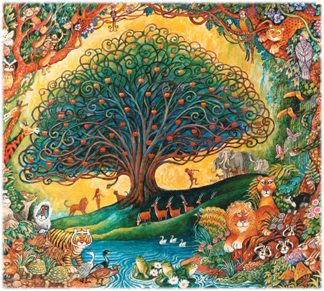
As we work our way through the Narrative Lectionary, this morning we begin in the second chapter of Genesis, the second creation story. Many of us know it as the story of Adam and Eve, or the story of the Garden of Eden. We’ll be reading just the beginning of that story today, from Genesis chapter two. Let us listen to these holy words of ancient scripture:
Genesis Chapter 2:4-7&15:
“The heavens and the earth when they were created, on the day that the Lord God made the earth and the heavens—there was no plant of the field yet in the earth, and no herb of the field had yet sprung up, for the Lord God had not caused it to rain upon the earth, and there was no one to till the ground; but a stream would rise from the earth and water the whole face of the ground. Then the Lord God formed man from the dust of the ground and breathed into his nostrils the breath of life, and the man became a living being. And the Lord God took the human one and put him in the garden of Eden to till it and keep it.”
For the Word of God in Scripture, for the Word of God among us, for the Word of God within us. Thanks be to God.
Last week, I told you about my friend and his annoying habit of flipping to the end of a novel to make sure it has a happy ending because he doesn’t like disappointing endings. For him, how it ends matters. And as we discussed last week, that’s important in life too. But I want to remind us that where we begin matters just as much.
Where we start has a great impact on where we’re going. Do we start with good news or bad news? Is it original sin or original blessing? Is God embarrassed by us, or are we exactly who God made us to be? Father Boyle tells a story about two young men, Beto and Eddie. They’re riding in the backseat of his car. Father Boyle is driving, and riding shotgun is a woman named Nicky from London. She works at the home office of a global network there.
Father Boyle turns to Beto and says, “Nicky, I heard in the New York Times that in London, they eat snails, right?” Nicky suggests, “No, maybe he’s thinking about France.” Father Boyle laughs and asks, “Hey, guys, tell Nicky how long you’ve been at Homeboy.” Beto replies, “Seven months.” Eddie adds, “I’ve been here four months, and three weeks as of today,” then he looks out the window and whispers almost to himself, “Best of my life.”
Father Boyle allows the words to rest in reverent silence. Later, he delivers a keynote speech to a group of school administrators. As he often does, he brings a couple of his “homeboys” with him, and he ends his talk the way he always does, by saying, “The day won’t ever come when I have more courage than Beto and Eddie.” He points to them in the front row, and the room, filled with thousands of school administrators, erupts in applause.
Father Boyle then shares a powerful message: “You are exactly who God had in mind when He made you.” He describes how both Beto and Eddie immediately sit up straighter in their chairs, as if an electric current has passed through them.
Afterward, while walking to the hotel’s underground parking garage, Eddie, who looks 12 but is actually 19, places his hand on Father Boyle’s shoulder and rests his head on his arm. He’s not tired; he’s tender. Eddie says, “Hey, G, you know what I love most about Homeboy? You’re not embarrassed by us.” Father Boyle reflects on those words, concluding, “The God we’ve settled for is red in the face and pretends not to know us at parties. But the God we actually have is never embarrassed by us.”
As Father Boyle says, “The desire of God’s heart is immeasurably larger than our imaginations can conjure. We often settle for less than intimacy with God when all God longs for is solidarity with us.”
So today, I want us to notice where the Bible begins. Before anything else happens, the Bible begins with good news. Too often, when we read the story of the Garden of Eden, we get distracted by the apple, the snake, and all of that. Of course, those things are part of the story, but we must not skip over the fact that God’s story begins with life—life that God breathes into humanity.
God doesn’t breathe life into us in some far-off, remote way. God gives the fullness of life, in all its goodness and complexity. As the poet Mary Oliver writes:
“Morning in the broken world, I beg of you, do not walk by without pausing to attend to this rather ridiculous performance. Just to be alive. Just to exist.”
A few years ago, Anderson Cooper interviewed late-night talk show host Stephen Colbert, and they reflected on something they share: tragedy struck both of them when they were around 10 years old. Anderson Cooper lost his father, and Stephen Colbert lost both his father and two of his older brothers in a car accident.
In this interview, Colbert shares how he learned to be grateful even in grief. He says, “It’s a gift to exist. And with existence comes suffering; there’s no escaping that. I didn’t learn to be grateful for the thing I most wish hadn’t happened; I realized it. And it’s an oddly guilty feeling. I don’t want it to have happened—I want it not to have happened. But if you are grateful for your life, you have to be grateful for all of it. You can’t choose what you’re grateful for.”
Colbert goes on to explain that from loss, we gain an awareness of other people’s suffering, which gives us empathy and allows us to connect more deeply. “It allows us to love more deeply and to understand what it’s like to be human.”
And that’s what I mean when I say it matters where we begin. With God, we always begin again with our own belovedness. You are a gift—exactly who God had in mind when God made you. Did you know that?
Yes, all kinds of things happen afterward—good and bad, joy and suffering, love and loss—but the God who loves us into loving never leaves us alone. In and through it all, what God longs for is solidarity with us.
So, I invite you to let this truth sink in once again: You are fearfully and wonderfully made.
Amen.


