
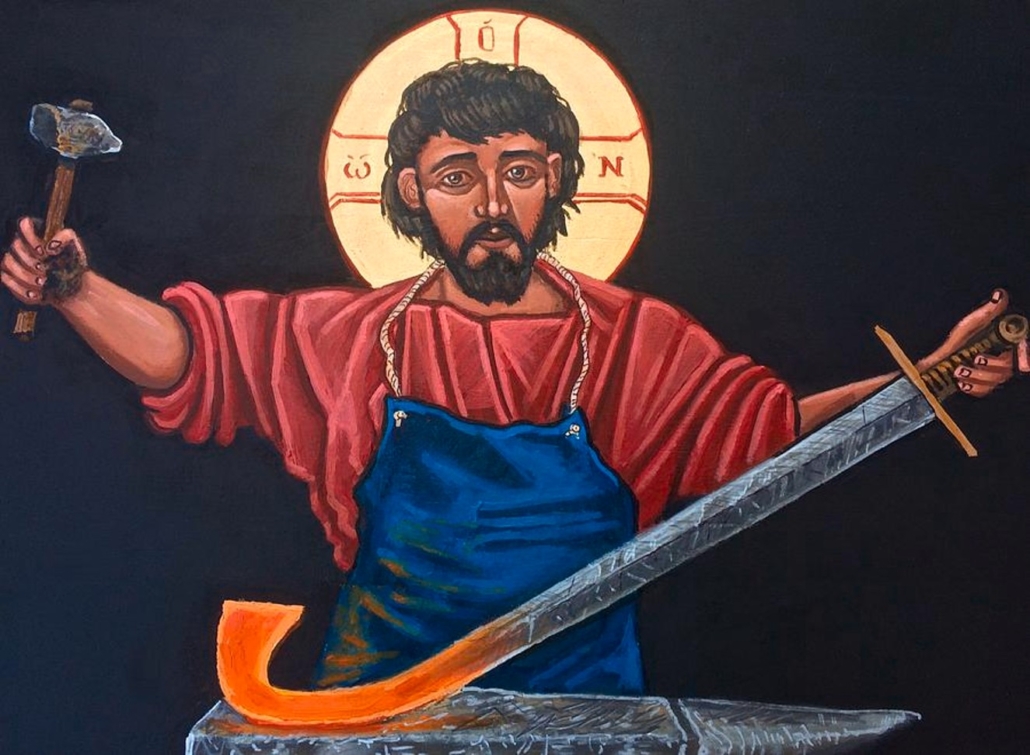
Sermon Transcript: November 22, 2026
Let us pray. Your word rings out, O God. Your voice echoes in every land, for you are the One whose powerful love reigns in every place. When we are afraid, remind us that we are your people, you have called us by name. Set our voices to singing your goodness and our feet to walking your way. Amen.
According to our church calendar, this is the last Sunday of the church year. Next Sunday begins the season of Advent, which is the beginning of the new church year, as we prepare for the arrival of the Christ child. On many church calendars, you’ll see today referred to as Christ the King Sunday or Reign of Christ Sunday.
As followers of the Narrative Lectionary here at Roland Park Presbyterian Church, we end on this grand vision of Isaiah’s about the reign of God that is to come, a time when all people will recognize and worship God’s goodness and be taught and live by God’s ways.
There’s actually more to our reading than what is printed in the bulletin. I’m not going to read it for us. It’s kind of long and a little bit confusing, with a bunch of different names, and so I’m going to summarize it for us so that we understand the gist of what it is saying. But first, I want to read to you Isaiah’s vision from chapter 2.
Isaiah 2:1-4
The word that Isaiah son of Amoz saw concerning Judah and Jerusalem.
In days to come
the mountain of the Lord’s house
shall be established as the highest of the mountains
and shall be raised above the hills;
all the nations shall stream to it.
Many peoples shall come and say,
“Come, let us go up to the mountain of the Lord,
to the house of the God of Jacob,
that he may teach us his ways
and that we may walk in his paths.”
For out of Zion shall go forth instruction
and the word of the Lord from Jerusalem.
He shall judge between the nations
and shall arbitrate for many peoples;
they shall beat their swords into plowshares
and their spears into pruning hooks;
nation shall not lift up sword against nation;
neither shall they learn war any more.
For the Word of God in Scripture,
For the Word of God among us,
For the Word of God within us,
Thanks be to God.
***
Our theme for this November has been growing in love. So for the past several weeks, we have been talking about how we grow in faith, how we as people of faith grow: how we grow in faith, how we grow in humility, how we grow in peace, and ultimately how we grow in love.
Laura Hirschfeld introduced us to the theme of growing in love with these words, another vision from the prophet Isaiah that describes God’s people as a well-watered garden, like a spring whose waters never fail. It’s from Isaiah 58. She said, “It’s a beautiful image of the church, a place that receives nourishment and grows while offering beauty, shelter, and sustenance for others.”
Isaiah is a great place to go for inspiration. It’s filled with beautiful visions of the world as it could be and should be, the world that God dreams for us, as we talked about last Sunday. And that vision includes our passage today from Isaiah 2.
Allie Rosner Bass writes, “Isaiah 2 opens with an image of the universal worship of Yahweh. The God who, up to this point in history, has been known as Israel’s national God is now depicted as a God to whom all nations are making pilgrimage. They seek God’s instruction and they desire to make God’s ways their ways. As all nations recognize the sovereignty of Yahweh, the relationships between those nations also change. Those who were once enemies, fighting under the banner of their own national deities, lay down their arms and turn them into tools designed for mutual flourishing.”
While Isaiah submits this as God’s vision, as God’s dream for the world, Isaiah is not so naive as to suggest that that vision is our reality. Quite the opposite. Isaiah is writing at a time of great distress and violence among the nations, with Israel and Judah being caught up in the midst.
As I said to you, there was more to today’s reading, but it was long. So instead of reading all of the prescribed verses, I decided to summarize them for us. If you want to read them, you can find them in chapters 36 and 37 of Isaiah.
Essentially, it is the story of how this vision of Isaiah 2 is put to the test. King Hezekiah and his people in Judah are being harassed by the neighboring powerhouse, the Assyrians. Their army is marching from town to town, demanding allegiance for protection. Those that refuse are decimated. And there’s already been one attempt at rebellion in the Judean countryside, and the second-largest town of Judah was destroyed.
So, with that message sent, the Assyrian king sends a messenger to warn the people not to trust King Hezekiah, their king, or God, saying they don’t have the power to save you.
Essentially, the Assyrian king, his army, and the messenger are telling them to give up their vision of peace through justice and unity. That vision is no match for the power and violence of the Assyrians. Their only hope, the messenger explains, is to submit and accept that this is the way the world is, whether you like it or not.
It’s an argument that runs not just through the book of Isaiah or the Old Testament, but throughout the entirety of Scripture. In his book—long title, hold on—How to Read the Bible and Still Be a Christian: Struggling with Divine Violence from Genesis Through Revelation—I mean, it just flew off the shelf, right?—John Dominic Crossan writes: “Throughout the biblical story, from Genesis to Revelation, every radical challenge from the biblical God is both asserted and then subverted by its receiving communities, be they the earliest Israelites or the latest Christians. That pattern of assertion and subversion, that rhythm of expansion and contraction, is like the cycle of the human heart.
In other words, the heartbeat of the Christian Bible is the recurrent cardiac cycle in which the asserted radicality of God’s nonviolent, distributive justice is subverted by the normalcy of civilization’s violent, retributive justice.”
These competing visions are woven throughout the biblical witness. And indeed, they are still alive and well in our world today.
Just in the past year, there have been at least two Army recruitment commercials using Scripture: one, the Lord’s Prayer, and the other, words from yet another vision from Isaiah, in which the prophet has a vision of the divine throne and responds to God’s calling, saying, “Here I am, send me,” as if God’s call was to war and not peace.
Additionally, the Secretary of Defense and his cronies like to quote Scripture, many times inaccurately, to justify warfare, to say that this is what God wants us to do. And the message is clear to them: We have the power, the weapons, and the willingness to use them. And this is proof that God is on our side, and therefore our way of life is blessed, while those who oppose us, who are different from us, are suspect or downright evil.
Take note that, according to our passage today, this combination of faith and justification of violence is the way of the Assyrians, not the vision of God.
“As a general rule,” Barbara Brown Taylor writes, “I would say that human beings never behave more badly toward one another than when they believe they are protecting God.”
Friends, God doesn’t need our protecting, and God does not condone our violence.
We can argue about where the line between defense and waging war is. We can argue about the role of force in a civilized society. But the moment we make God violent or condoning of our violence, we are guilty of creating God in our own image. And we’ve stopped believing in the vision that Isaiah put forth, a vision that a better world is possible.
“The prophet engages in futuring fantasy,” writes Walter Brueggemann. “The prophet does not ask if a vision can be implemented, for questions of implementation are of no consequence until the vision can be imagined. The imagination must come before the implementation.”
Thus, he writes, “Every totalitarian regime is frightened of the artist. It is the vocation of the prophet to keep alive the ministry of imagination, to keep on conjuring and proposing futures alternative to the single one that the king wants to urge as the only thinkable one.”
Sometimes I doomscroll on my phone. Do you all do that? You just start, you’re looking for something, and then you just kind of keep going, and you see all the different things, the bad news.
Every once in a while—and I’m so grateful for this; it’s evidence to me of God’s grace—that doomscrolling gets interrupted by something unexpected. I had that happen to me this week. I saw a very Karen-looking woman approaching the house of her Muslim neighbor, and I thought, “Oh, here we go.”
The woman knocks on the door and says to her neighbor, “My friend and coworker passed away, and I’m going to her funeral at the mosque. But I don’t have a head covering, and I don’t know how I’m supposed to wear it. Could you help me?”
And the woman said, “Sure, just wait right here a moment.” And she went away and came back with a headscarf. Then she modeled for her how to put it on, putting it on top of her own headscarf and showing her how you put it over the top and around. She opened the door and handed it to her.
And the woman said, “Oh, I can borrow this? Are you sure?” And she said, “No, no, no. You can have it. I have plenty.” She says, “Oh my goodness. Thank you so much.” She turns to leave, and the woman says, “No, no, wait. Show me how you want to put it on. Let me see. Let me help you.”
And the woman started to put it on, and she couldn’t quite figure it out. She said, “No, here, remember?” And she showed her, and she said, “Thank you.”
Friends, another world is possible.
Advent starts next week. Advent invites us to keep faith in God’s vision, God’s dream, in the midst of a world that only knows how to subvert that vision with our own violence and retribution.
It’s not that we desire violence over peace. We just don’t believe that peace and love are enough when push comes to shove. We don’t believe in the power of humility and grace. We don’t believe in the healing power of forgiveness and mercy. We want to. We want to.
We just have too many counterpoints bombarding us day in and day out, in the news and on our screens. And so we become numb to it. And we don’t feel the pain of those on the other side of the world or globe, or even the other side of the street. And we too often believe those who tell us that they, whoever they are this week, are a threat to our way of life.
So, as people of faith, we have to be honest. Our lives do not always show our commitment to God’s vision.
But Advent reminds us that the Prince of Peace is coming and, indeed, is already here. It reminds us that we are followers of his, and Jesus’ way is definitely one of nonviolence. Jesus shows us who God really is, and that a life like his is not beyond our reach.
And so, for a few weeks, we’re going to continue to steep ourselves in God’s vision for our world. And we’re going to remind ourselves of who God calls us to be: people of faith and vision, people of love and peace, who not only believe, but try, in our own feeble way, to live the dream that God has for us.
And along the way, we will remind ourselves that we are made in God’s image and not the other way around. Amen.


