
Sermon Transcript: August 3, 2025
I feel like I have so much to say, I don’t know where to start today. But let me start here.
Last Sunday, I woke up in a tent in the middle of a field in Wisconsin. And later that day, we packed up the tents, and I took my son and two of his buddies, and we started the long drive back to Maryland and back to Baltimore. Took us two days. And on that way, I started noticing all of these signs. And it kind of culminated in Western Maryland.
I think it’s maybe—I forget if it’s 68 or 70. Have you all seen the ark that’s out there? Yeah. And there’s an ark, like, as it’s being built. And it just struck me how bizarre Christians can be. And these signs, I just thought, they’re such a bad—I mean, you know, it’s all the, you know, fire and brimstone stuff. And I just thought, does this work on anybody? And I just felt like it’s such a poor representation of our faith.
And so, I’m just so glad to be back with all of you and to see the genuine affection that we have for one another during the passing of the peace. And I’m really grateful to have a congregation where I can do a series on Revelation. And that’s okay with you all—or at least I think it is, I don’t know. Maybe it’s not and you’re just being nice.
But Annie Dillard once said, if Christians believe half of what they say, then church pews should come equipped with seat belts rather than cushions. And that’s very appropriate for today, because I think we’re going to want to strap in for what may be one of the most bizarre readings you’ll ever hear in church. And yes, I am wondering, why did I do this to myself?
But let me give you a little bit of background before we jump into this passage from Revelation, just to understand the context of what happened in chapter 12, which is really important and relevant to what I’m about to read.
And that is—it tells a vision of heaven, and there’s a war in heaven. And there’s a dragon who’s called Satan. By the way, Satan in scripture simply means the opposer, the one who opposes. It’s kind of a courtroom image—you have a defense lawyer and a prosecutor. So the Satan is the one who opposes God, kind of a counter argument.
But anyway, in this vision, the dragon—Satan—is defeated and is banished from heaven, but is inexplicably given authority over earth and all the people to do whatever the dragon wishes. And so you’ll hear reference to the dragon in this, and that’s where the authority is coming from in this vision.
So here we go.
Revelation 13:1–18 & 17:1–6 (NRSV)
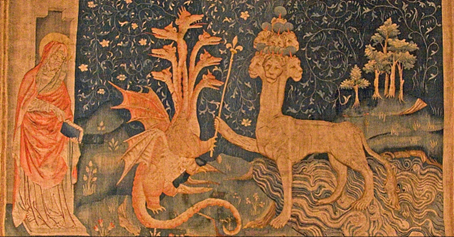
And I saw a beast rising out of the sea, with ten horns and seven heads, and on its horns were ten diadems, and on its heads were blasphemous names. And the beast that I saw was like a leopard, its feet were like a bear’s, and its mouth was like a lion’s mouth. And the dragon gave it his power and his throne and great authority. One of its heads seemed to have received a death blow, but its fatal wound had been healed. In amazement the whole earth followed the beast. They worshiped the dragon, for he had given his authority to the beast, and they worshiped the beast, saying, “Who is like the beast, and who can fight against it?”
The beast was given a mouth speaking arrogant and blasphemous words, and it was allowed to exercise authority for forty-two months. It opened its mouth to speak blasphemies against God, blaspheming his name and his dwelling, that is, those who dwell in heaven. Also, it was allowed to wage war on the saints and to conquer them. It was given authority over every tribe and people and language and nation, and all the inhabitants of the earth will worship it, everyone whose name has not been written from the foundation of the world in the book of life of the Lamb that was slaughtered.
Let anyone who has an ear listen:
If you are to be taken captive,
into captivity you go;
if you kill with the sword,
with the sword you must be killed.
Here is a call for the endurance and faith of the saints.
Then I saw another beast that rose out of the earth; it had two horns like a lamb, and it spoke like a dragon. It exercises all the authority of the first beast on its behalf, and it makes the earth and its inhabitants worship the first beast, whose fatal wound had been healed. It performs great signs, even making fire come down from heaven to earth in the sight of all, and by the signs that it is allowed to perform on behalf of the beast it deceives the inhabitants of earth, telling them to make an image for the beast that had been wounded by the sword and yet lived, and it was allowed to give breath to the image of the beast so that the image of the beast could even speak and cause those who would not worship the image of the beast to be killed. Also, it causes all, both small and great, both rich and poor, both free and slave, to be given a brand on the right hand or the forehead, so that no one can buy or sell who does not have the brand, that is, the name of the beast or the number for its name. This calls for wisdom: let anyone with understanding calculate the number of the beast, for it is the number for a person. Its number is six hundred sixty-six.
Then one of the seven angels who had the seven bowls came and said to me, “Come, I will show you the judgment of the great whore who is seated on many waters, with whom the kings of the earth have engaged in sexual immorality and with the wine of whose prostitution the inhabitants of the earth have become drunk.” So he carried me away in the spirit into a wilderness, and I saw a woman sitting on a scarlet beast that was full of blasphemous names, and it had seven heads and ten horns. The woman was clothed in purple and scarlet and adorned with gold and jewels and pearls, holding in her hand a golden cup full of abominations and the impurities of her prostitution, and on her forehead was written a name, a mystery: “Babylon the great, mother of whores and of earth’s abominations.” And I saw that the woman was drunk with the blood of the saints and the blood of the witnesses to Jesus.
When I saw her, I was greatly amazed.
For the Word of God in scripture,
For the Word of God among us,
For the Word of God within us,
Thanks be to God.
***
There are a lot of things in the Bible. There are all kinds we think are in the Bible, but they’re not. Let me give you some examples—see if you can pick them out:
“God helps those who help themselves.” Not in the Bible.
“Give a man a fish, he will eat for a day. Teach a man to fish, and he will eat for a lifetime.” Not in the Bible.
“Eat, drink, and be merry.” In the Bible—you guys are good! Ecclesiastes, even. All right. I must be doing an okay job.
Then there are things that we extrapolate or fill out in the Bible.
For example, what did Eve give to Adam? Apple. It actually just says fruit. We just kind of filled it out—the detail. We said, fruit? Okay. I don’t know.
What about Jonah? Jonah was swallowed by a big fish. Yeah, but we commonly say whale.
How many wise men are there? None! It’s an oxymoron. No—yeah, we say three, but the Bible actually doesn’t give a number. There’s more than one, because it’s plural.
And likewise, there are things that are in the Bible that shock us as well. And I would rank today’s reading at the very top. If I had just read that out to you and said, “Does this appear in the Bible?” I’m going to guess a lot of us would be like, I don’t think so. Or we might just say, I hope not.
But there it is—a beast with seven heads, another with two horns, a dragon that wields authority over Earth and its people, a woman who drinks the blood of the saints. What in the world is going on here? I mean, it’s almost like we’re reading The Lord of the Rings, not Holy Scripture.
But that’s actually kind of the point. Because, you see, it’s meant to be memorable. It’s meant to be graphic and violent. But why?
Does John, the author, think this is what God’s future looks like? Or is he describing something that’s more pressing?
And you can find a lot of books that attempt to decode the visions of Revelation—people who will claim that they’re able to decipher the true meaning of all the symbols. Take the number 666, for example. I’m sure you’ve all seen many different usages or explanations of that number and what it means. And all of these have one thing in common, and that is simply that they miss the point entirely.
Let me say this very, very clearly:
There is no book, there is no writing, there is no wise person or prophet who can tell us about the future. The future hasn’t happened yet. Period.
It is, by definition, unknowable. We can make predictions to make it sound like we know. For example, I predict that the Orioles will not win the World Series this year. Boo. I don’t play for them!
But no one can predict anything that isn’t already obvious. And that includes the Bible.
So again, let me say this very clearly:
Revelation is not about the future. The future is just the setting. Like Star Trek or any other work of fantasy or science fiction, the author of Revelation is using this style of storytelling to help his readers and listeners make sense of their present circumstances.
And their present circumstances are dominated by the beastly Roman Empire. The people are living under an oppressive rule of people from another land. They are being used. They live in fear and they long for freedom and justice.
And the imagery and message that we encounter in the book of Revelation that is so strange to us would have been plain as day to the original audience. Without an understanding of that context, however, you and I are lost to find its meaning.
But by understanding that original context, we can decipher parts of the message that are timeless and apply them to our lives and world.
And we don’t have to decipher any fancy codes to do it. We don’t need to understand the secret meaning behind 666. It’s enough to know that the author is talking about the Roman Empire—which to them seemed all-powerful and like it would last forever.
We, of course, know that it didn’t last forever. Because empires never do.
This, by the way, is why Christian nationalism is such a bad idea from a faith perspective. Now, we could write a long list of reasons that Christian nationalism is bad, but from a faith perspective, it’s bad because all empires, all countries, all nations, all leaders—presidents, kings—end. Every single one.
Why would we want our faith tied to something so fragile?
Author Neil Gaiman writes: Fairy tales are more than true—not because they tell us that dragons exist, but because they tell us dragons can be defeated.
We can easily substitute the word fairy tale for Revelation.
Revelation is not true because at some point in the future a beast will rise up from the sea and fire will come down from heaven and God’s wrath and judgment will come to the earth. It’s true because these things already exist.
But the good news is: They will not last. And they can be defeated.
In the first sermon in this series, I equated the book of Revelation to the children’s book Good Night, Gorilla.
Today, I want to suggest that the meaning of Revelation can be summarized by a New Yorker cartoon. This particular cartoon first appeared in the New Yorker in November or December of 2001, just a short time after the horrific attacks of 9/11.
The cartoon is of a disheveled man on a street corner holding a sign. But instead of the expected message, “The end is near,” the sign simply read: “It’s going to be all right.”
Now, not much was funny at that time. Grief and fear still held a tight grip on us. We felt very unsure about the future. We felt vulnerable in a way that many of us had never felt before. We didn’t know that it was going to be all right—not by a long shot.
The humor of that cartoon came in understanding the context. During normal times, it wouldn’t have made much sense. But given the context, after 9/11, even if it didn’t make one laugh out loud, it perhaps helped its audience breathe just a little bit easier.
Likewise, Revelation is a reminder that despite our fears and uncertainties—despite whatever current chaos of our world or—it’s going to be all right.
Because God gets the last word.
It will not be the vision of empires or tyrants or even any of us that gets the last word, but God’s vision of a new heaven and a new earth.
But this vision should not make us passive, simply waiting for God to come and fix it all. Rather, this vision is meant to give us courage in the face of the beasts of our day—wherever and whoever they might be.
James Baldwin reminds us that not everything that is faced can be changed, but nothing can be changed until it is faced.
So whether the beast is authoritarianism, racism, Christian nationalism—it is our job to unmask the beast and to remember that it does not get the last word.
If we want to know what God’s vision for us is, it’s right here before us.
Every Sunday, we gather around this table, and we are reminded of that great heavenly banquet where all are fed, all are welcomed, and all are loved and cared for.
And we do this here not to remind us that heaven is some far-off future reality, but a present possibility.
Because each one of our tables at home can resemble the Lord’s table—if we allow it. We can share. We can do the necessary hard work of loving our neighbors.
Friends, Jesus didn’t come like a knight in shining armor to rescue us from bad guys. He came to remind us of our power and responsibility as children of God, capable, as the prayer we pray every Sunday says, to do God’s will here on earth as it is in heaven.
Amen.


