
Sermon Transcript: August 10, 2025
We continue today in our series on the book of Revelation. This is the third in the series, and I want to do a little bit of a recap — to remind us where we’ve been — so that we can go together where we need to go from here.
But first — what are some of your takeaways so far about the book of Revelation?
Yes, Barrie.
That it’s written to the Jewish people about their occupation by the Roman Empire. So it’s not necessarily a book about the future and what will happen, but about what is already happening, and the devastation in which the people of God at that time are living — trying to survive.
Very good. What else?
Yes, Christine.
That it’s singular.
Thank you, Christine. That’s one of my pet peeves. Remember — it’s not Revelations; it’s Revelation. Because it is one whole vision by John — his vision of God’s kingdom come. It’s not a series of revelations; it’s a revelation.
What else? Yes?
Right, it most likely was not written by the same John who wrote the Fourth Gospel. This is another, later John — someone who seems to have been in political exile on the island of Patmos.
Anything else? Yes, Barrie again.
It’s about resistance — about how we as people of faith, as Christians, can resist the empire, the powers of this world.
What about last week?
We talked about the really bizarre description of the beast. Remember — the beast with seven heads, and then another beast, and there was a dragon. What’s with all that?
Joyce?
The dragon can be slain, right?
Yes. I used a quote from fantasy author Neil Gaiman, who said something along the lines of: Fairy tales are more than true — not because they tell us dragons are real, but because they tell us dragons can be defeated.
It’s about this idea that some of the forces in our world seem insurmountable to us, but the reminder is that they are indeed not — they are mortal, and they can be defeated.
That’s a pretty good recap of where we are. Anything else?
What about the word apocalypse?
Revelation and apocalypse are kind of synonyms. Apocalyptic literature is a genre of biblical writing — like Isaiah, Daniel. What about that word apocalypse? What’s the meaning behind it?
We tend to think of it as future, destruction, and chaos, right? But it’s really… giving you all a hint here… pulling back the curtain.
Yes — it’s this idea that apocalypse means “reveal.” It’s about pulling back the curtain on the reality that we see. The reality we see is there, but behind it — within it, beyond it — is another reality that we call the kingdom of God. And every once in a while, we get a glimpse of it — a peek behind the curtain — to see not just things as they are, but as they could be, as they should be… perhaps ultimately as they truly are in God’s kingdom.
And with that, we turn to chapter five.
Now, you may realize if you’ve been paying close attention that we are going out of order — and we are. We jumped ahead to the beast last week to kind of get that out of the way. That was chapters 13 and 17. Now we’re pulling back to chapter five, and we’ll jump back again next week to fill in a little more.
Today we hear about another main character. Last week we heard about the beast. This week we hear about the Lamb.
Revelation 5:1-14 (NRSV)
Then I saw in the right hand of the one seated on the throne a scroll written on the inside and on the back, sealed with seven seals, and I saw a mighty angel proclaiming with a loud voice, “Who is worthy to open the scroll and break its seals?” And no one in heaven or on earth or under the earth was able to open the scroll or to look into it. And I began to weep bitterly because no one was found worthy to open the scroll or to look into it. Then one of the elders said to me, “Do not weep. See, the Lion of the tribe of Judah, the Root of David, has conquered, so that he can open the scroll and its seven seals.”
Then I saw between the throne and the four living creatures and among the elders a Lamb standing as if it had been slaughtered, with seven horns and seven eyes, which are the seven spirits of God sent out into all the earth. He went and took the scroll from the right hand of the one who was seated on the throne. When he had taken the scroll, the four living creatures and the twenty-four elders fell before the Lamb, each holding a harp and golden bowls full of incense, which are the prayers of the saints. They sing a new song:
“You are worthy to take the scroll
and to break its seals,
for you were slaughtered and by your blood you ransomed for God
saints from every tribe and language and people and nation;
you have made them a kingdom and priests serving our God,
and they will reign on earth.”
Then I looked, and I heard the voice of many angels surrounding the throne and the living creatures and the elders; they numbered myriads of myriads and thousands of thousands, singing with full voice,
“Worthy is the Lamb that was slaughtered
to receive power and wealth and wisdom and might
and honor and glory and blessing!”
Then I heard every creature in heaven and on earth and under the earth and in the sea and all that is in them, singing,
“To the one seated on the throne and to the Lamb
be blessing and honor and glory and might
forever and ever!”
And the four living creatures said, “Amen!” And the elders fell down and worshiped.
For the Word of God in scripture,
For the Word of God among us,
For the Word of God within us,
Thanks be to God.
***
I was probably about ten years old, at my grandparents’ house in Western Pennsylvania. My grandfather was sick. He had Alzheimer’s — which at the time I misheard as “old-timers.” We had visited him in the nursing home that day, and my young mind was still dealing with how my grandfather — whose rather intimidating presence in full health had always loomed large — now seemed so weak and frail lying in his bed.
He could barely talk — just a few words. He didn’t know who we were. And I thought to myself: How can this be? How can this strong, imposing man be brought so low?
That night I had trouble sleeping. Fortunately, I had just learned that my favorite book — The Lion, the Witch, and the Wardrobe — was only the first in a series of seven books called The Chronicles of Narnia. Somehow I had acquired the whole set — I don’t remember how — so I lay there that night with a flashlight under the covers, reading late, late into the night… amazed that the adventures of Peter, Susan, Edmund, and Lucy were not over, but had just begun.
At the time, I didn’t know all that I was reading. I knew it was a good story — fun, full of imagination. Later, I would learn that C.S. Lewis, the author, was a scholar and Christian who drew heavily on biblical themes and imagery to create the fictional world of Narnia and its many inhabitants.
At the center of this magical world is a majestic and mysterious character named Aslan. How many of you remember Aslan?
Aslan is a lion who appears at crucial moments in the story. Now, a lion made sense to me — king of the jungle, most powerful of the creatures. Of course a lion would be king of a place like Narnia. But this lion was different. He could talk — which is handy — but more than that, he was gentle. Once they got to know him, the children would run to Aslan, hug him, ride on his back, even tug playfully at his mane. Not exactly a fearsome beast. And yet, in the face of evil and danger, Aslan could roar and leap into battle if he chose.
Upon first hearing about Aslan, the children are unsure. “A lion?” they ask. “Is he safe?” The response they get is one of the classic lines of the first book:
Safe? Who said anything about safe? Of course he isn’t safe. But he is good.
Now — some of you know this part — at a crucial point in the story, Aslan gives himself up to protect his friends and the vulnerable creatures of Narnia. When I read that for the first time, I thought, “Why would he do that? Surely the lion could fight and win. He’s the fiercest of all the creatures!”
What I couldn’t articulate at the time was that the story was inviting me to rethink my assumptions about power and strength. And without fully realizing it, as I grieved my grandfather, I was seeing strength like I’d never seen before — in my grandmother, who visited him daily, cared for him, and in my mother, who took us to see her father, explained his illness, and comforted us even as she grieved herself.
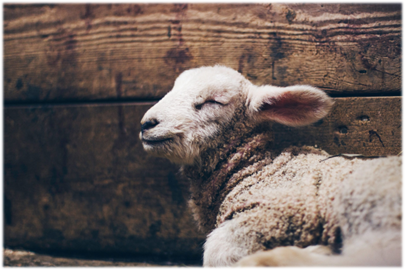
In our passage today, even the heavenly beings expect a lion — the Lion of Judah — to come and open the scroll. But no lion arrives. In his place, John sees a Lamb, standing as if slaughtered. Where John expects lion power, there is lamb power. And throughout the rest of Revelation, the Lamb becomes the primary symbol for Jesus Christ — power not through violence, but through faithful witness, vulnerability, and love.
Indeed, throughout the rest of Revelation, the Lamb provides the primary symbol for Jesus Christ. In this vision, lion power has been displaced by lamb power. Lamb power challenges us to reconsider our assumptions about power. It proclaims that God rules not by violence, but by Jesus’ faithful witness — Jesus, the one crucified by the Roman Empire for being a political nuisance. Jesus, the victim.
When I was in fifth grade — so probably about the same time as my previous story — I encountered a serious problem. You see, I had gathered a bit of a reputation as one of the top dogs in my class. I don’t think I was unkind per se, but I could be a bit “lippy,” as someone once called me. That worked well for me in grades one through four. But in fifth grade, something happened that changed everything.
Growth spurts.
Everyone started growing taller and taller… except for me. Suddenly, I went from top dog to bottom of the ladder. And all of a sudden, my mouth went from being an asset to getting me in trouble on a regular basis.
So, I quickly realized I was in over my head. And I befriended Danny. Well — actually, Danny and I were already friends. I just made sure to keep him really close by. Because Danny was the biggest guy in our grade. He grew up on a farm. He had these big, broad shoulders. Danny literally went on to play in the NFL. That was Danny. He was my safety net in fifth grade. If Danny was near, no one would mess with me.
The thing about Danny, though, was that he was just about the nicest person you would ever want to meet. Polite. Always kind to everybody. And I never once saw Danny get in a fight. He was a gentle giant.
Today’s passage makes us question our assumptions about power. Do we define power as strength over others — the ability to bend others to our will, to make them serve us?
Revelation asks: What about the power of love?
Nelson Rockefeller said, “Never forget that the most powerful force on the earth is love.” And essentially, the book of Revelation is saying: Do we really believe that?
The way we know whether we really believe that is to look at what — or who — we worship. What or who we give our allegiance to, our loyalty. Who do we rely on when push comes to shove? When our backs are against the wall?
Do we trust the beasts — the ones we read about last week — who tell us that might makes right? The lions of this world — the big, the powerful?
Or dare we worship the Lamb, and its Lamb power?
Last week we were reminded that the beasts of this world, that seem to exercise so much control and influence over us, are not as powerful in reality as they seem. The biblical truth is that every empire, every king, every emperor comes to an end.
The 33rd Psalm says:
The Lord looks down from heaven;
he sees all humankind.
From where he sits enthroned, he watches all the inhabitants of the earth —
he who fashions the hearts of them all,
and observes all their deeds.
A king is not saved by his great army;
a warrior is not delivered by his great strength.
The war horse is a vain hope for victory,
and by its great might it cannot save.
Truly, the eye of the Lord is on those who fear him,
on those who hope in his steadfast love…
Our soul waits for the Lord;
he is our help and our shield.
Our heart is glad in him,
because we trust in his holy name.
Let your steadfast love, O Lord, be upon us,
even as we hope in you.
That is faith in the Lamb — not in the strength and powers of this world, but in the revelation of God’s love, the power of God’s love, and the vulnerability that comes with love.
The book of Revelation invites us to consider that the Lamb is worthy of our worship and our loyalty. It asks us if we truly believe that love is the final word — the final authority.
Which is why, in many ways, it’s actually the perfect book to place at the end of the anthology we call the Bible. Because just about every page of scripture since the giving of the Ten Commandments has been about trying to convince us that the God to whom the Bible bears witness is not the God of our own creating.
All those ideas and images we have of God — that’s the God of our own creating. The God of the Bible is something different. Something other. And we have to be reminded of that regularly, because our own minds and the world around us try to convince us each and every day that the beast cannot be defeated, that might does make right, and that the Lamb is not worthy of our worship but of our scorn.
That’s why we come here week after week after week, proclaiming the same message — because we need reminding. Because it’s so different. It’s so counter-cultural. It’s so counterintuitive.
But that is the whole of the biblical witness — that God is not the God of our creating. God is something else.
Walter Brueggemann puts it this way: The first commandment is a declaration that the God of Exodus is unlike all the gods the slaves have known heretofore. This God is not to be confused with or thought parallel to the insatiable gods of imperial productivity. This God is subsequently revealed as a God of mercy, a God of steadfast love, a God of faithfulness, who is committed to covenantal relationship of fidelity with God’s people.
Let me put the whole thing another way: If we’ve been putting our faith in the wrong kind of power all this time, what examples of power have we overlooked in the meantime?
Acts of caring and compassion. Acts of service to others. Acts of vulnerability and self-sacrifice.
And perhaps even more to the point — if love is the most powerful force in the world, if love is what will outlive us in the end — then how are we to live now? How are we to treat each other now?
What does the power of love require of us? And how can we show a world that is so enamored by the power of the beast — the power of dragons and lions and empires and emperors — that the Lamb is indeed worthy of our worship, our praise, our loyalty… our lives?


