
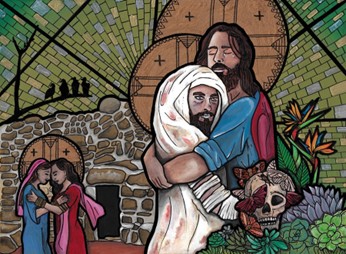
Our reading today comes from the 11th chapter of John’s Gospel, verses 1 through 41.
John 11: 1-41
Now a certain man was ill, Lazarus of Bethany, the village of Mary and her sister Martha. Mary was the one who anointed the Lord with perfume and wiped his feet with her hair; her brother Lazarus was ill. So the sisters sent a message to Jesus, “Lord, he whom you love is ill.” But when Jesus heard it, he said, “This illness does not lead to death; rather, it is for God’s glory, so that the Son of God may be glorified through it.” Accordingly, though Jesus loved Martha and her sister and Lazarus, after having heard that Lazarus was ill, he stayed two days longer in the place where he was.
Then after this he said to the disciples, “Let us go to Judea again.” The disciples said to him, “Rabbi, the Jews were just now trying to stone you, and are you going there again?” Jesus answered, “Are there not twelve hours of daylight? Those who walk during the day do not stumble because they see the light of this world. But those who walk at night stumble because the light is not in them.” After saying this, he told them, “Our friend Lazarus has fallen asleep, but I am going there to awaken him.” The disciples said to him, “Lord, if he has fallen asleep, he will be all right.” Jesus, however, had been speaking about his death, but they thought that he was referring merely to sleep. Then Jesus told them plainly, “Lazarus is dead. For your sake I am glad I was not there, so that you may believe. But let us go to him.” Thomas, who was called the Twin, said to his fellow disciples, “Let us also go, that we may die with him.”
When Jesus arrived, he found that Lazarus had already been in the tomb four days. Now Bethany was near Jerusalem, some two miles away, and many of the Jews had come to Martha and Mary to console them about their brother. When Martha heard that Jesus was coming, she went and met him, while Mary stayed at home. Martha said to Jesus, “Lord, if you had been here, my brother would not have died. But even now I know that God will give you whatever you ask of him.” Jesus said to her, “Your brother will rise again.” Martha said to him, “I know that he will rise again in the resurrection on the last day.” Jesus said to her, “I am the resurrection and the life. Those who believe in me, even though they die, will live, and everyone who lives and believes in me will never die. Do you believe this?” She said to him, “Yes, Lord, I believe that you are the Messiah, the Son of God, the one coming into the world.”
When she had said this, she went back and called her sister Mary and told her privately, “The Teacher is here and is calling for you.” And when she heard it, she got up quickly and went to him. Now Jesus had not yet come to the village but was still at the place where Martha had met him. The Jews who were with her in the house consoling her saw Mary get up quickly and go out. They followed her because they thought that she was going to the tomb to weep there. When Mary came where Jesus was and saw him, she knelt at his feet and said to him, “Lord, if you had been here, my brother would not have died.” When Jesus saw her weeping and the Jews who came with her also weeping, he was greatly disturbed in spirit and deeply moved. He said, “Where have you laid him?” They said to him, “Lord, come and see.” Jesus began to weep. So the Jews said, “See how he loved him!” But some of them said, “Could not he who opened the eyes of the blind man have kept this man from dying?”
Then Jesus, again greatly disturbed, came to the tomb. It was a cave, and a stone was lying against it. Jesus said, “Take away the stone.” Martha, the sister of the dead man, said to him, “Lord, already there is a stench because he has been dead four days.” Jesus said to her, “Did I not tell you that if you believed you would see the glory of God?” So they took away the stone. And Jesus looked upward and said, “Father, I thank you for having heard me.
For the Word of God in scripture,
For the Word of God among us,
For the Word of God within us,
Thanks be to God.
***
Well, this past Wednesday, many of us marked ourselves with ashes as we began the season of Lent. Lent may be just about the most important season on the calendar for us Christians. A significant part of our faith is often overlooked. But I also understand the desire to pay Lent only passing mind. It seems like such a downer. Let’s talk about our mortality, our frailty, and our brokenness, and our proclivity to wander from God.
That sounds like fun, right?
I don’t know anyone who enjoys Lent or counts down the days toward Lent like we do Christmas. And it doesn’t help that it comes when it does during the year, weather-wise. During the darkest days, cold temps, many already feel down and isolated at this time of year. And then there’s the state of affairs in our country and around the world: war, greed, hunger for power, exploitation, climate disaster.
We get the point. I don’t need to remind us how depressing things can be right now. But the point is this: we need Lent not to remind us how bad things can get. What we need is for Lent to show us what can be redemptive in our mortality, in our frailty, in our brokenness. Lent, you see, is asking us to face these realities, though not through the lens of fear and judgment, but through trust in God’s love and providence.
We need to know that God is with us, not just on the mountaintop, but in the valley as well. Charles Ringma writes, “If we hold to the idea that God gives but does not take away, then in the midst of loss our faith may suffer a severe crisis. Loss invites us to the strange journey of surrender and faith. It pulls us into the abyss. It sends us into the dark tunnel where we expect to find nothing and no one.
“But someone can be found. And this may not be the God who rescues. It may simply be the God of the dark day on Golgotha’s lonely hill. The God who experienced the greatest loss and who promises us companionship on this difficult journey with no end or solution in sight, except the promise that this God is also the God of resurrection. And this God may be found when all else is taken away.”
Our passage today is the turning point of John’s Gospel.
It represents the last of the signs that John has been so fond of, as well as the last of the “I am” statements, although I think a few of them are repeated.
The other thing about this transition is that time is about to change.
You see, the first half of John’s Gospel, the first ten chapters, covers a period of years.
The second half, from here on out, is merely one week—the last week of Jesus’ life. You see, John thinks it’s important for us to slow down, to take in every detail and reflect on this beautiful life that is about to be extinguished before us.
To do this, John does what John always does. He introduces us to a character. Like Nicodemus, or the woman at the well, or the man born blind from birth, John insists that the gospel is transmitted not simply through words and actions, but relationships.
And we are told that Jesus loves Lazarus, the character that we meet today. He’s not just some acquaintance, but seemingly a dear, dear old friend.
And so it’s odd that when Jesus first gets word that Lazarus is ill, that he stays put.
I guess it makes sense. Jesus is surrounded by folks who are ill and in need of attention. But he says, “This illness does not lead to death.”
But it turns out that he was wrong, right? Because the next thing we know, Jesus is telling the disciples that Lazarus has died. And so they set off to the site of the tragedy, where they find Mary and Martha, the two sisters, who are grieving and asking Jesus why he didn’t show up earlier.
Now one thing becomes very clear when you read John’s Gospel, is that Jesus never appears flustered or out of control. He’s always in the driver’s seat. What happens is always what he intends to happen. If we were to do some sort of graphic or pie chart of how each of the Gospels views Jesus in terms of his humanity and his divinity, John would be the highest on the divinity. While Matthew and Mark and Luke portray Jesus as mostly human with divine connections, John’s Gospel—notably the last one to be written—has Jesus as mostly divine, with just a touch of human showing through.
You following me?
And we see that glimpse of humanity in our reading today, which makes it all the more potent, I think. Because Jesus says all is going according to plan, yet when he arrives, he finds the reality that his friend Lazarus is dead. And we get the shortest and perhaps most powerful verse in all of scripture. In some translations: “Jesus wept.”
John wants us to know this is not a show. It’s not an illusion. It’s not a prank. It’s not a magic trick. Lazarus really died. Jesus wept.
The sisters are grieving. The disciples are dumbfounded.
Now we know, because we’ve read the Gospel before, the raising of Lazarus is obviously a precursor to Jesus’ own resurrection. It is John’s way of saying, as the quote on our bulletin cover by Frederick Buechner states, “The resurrection of Jesus means that the worst thing is never the last thing.”
John’s way of saying we are about to go through some stuff as we encounter the last week of Jesus’ life. We’re about to face our mortality, our frailty, our brokenness head-on. But do not fear, for the divine is with you to comfort you, even in life’s deepest, darkest valleys, even in death.
In his book The Promise of Despair, Andrew Root writes, “Love is only able to conquer death if it goes through death. Love is only able to conquer death by dying.” Or to say it another way, love is only love if it is found next to death, if it is found next to darkness, yearning, and brokenness.
Friends, God has chosen us. God will not be God without us.
God will not rescue us from all pain and suffering, nor the consequences of our own actions, but God has shown us nowhere we can go that God will not go with us.
This Lent, may we begin to learn to embrace our frailty, our brokenness, and yes, even our mortality, as opportunities to experience the loving embrace of our Creator. Let us not be afraid to be known. Let us not be afraid to admit our mistakes and our failings.
And most of all, let us not be afraid to walk through the valley with each other and with our God, knowing that the worst thing is never the last, and that the only way to heal is first to admit our brokenness.
And then we can watch as love pours in the cracks.
Amen.


