
Sermon Transcript: January 12, 2025
We continue our journey in Luke’s Gospel. Just a reminder of Luke’s place in the Gospels: Luke is the most oriented toward the outsider—the other, the Gentile, the non-Jew. He is also perhaps the one most attuned to the political environment.
As we’ll see at the beginning of this passage, it is quite common for Luke to set whatever story he’s going to tell by naming who’s in power at that time. He does this thing where he starts with the big picture: “This is where we are.” Then, like a good film director, he zooms out from that macro perspective into a more local, intimate scene.
Luke 3:1-22
In the fifteenth year of the reign of Tiberius Caesar, when Pontius Pilate was governor of Judea, and Herod was ruler of Galilee, and his brother Philip ruler of the region of Iturea and Trachonitis, and Lysanias ruler of Abilene, during the high priesthood of Annas and Caiaphas, the word of God came to John, son of Zechariah, in the wilderness.
He went into all the region around the Jordan, proclaiming a baptism of repentance for the forgiveness of sins, as it is written in the book of the words of the prophet Isaiah:
“The voice of one crying out in the wilderness:
Prepare the way of the Lord,
make his paths straight.
Every valley shall be filled,
and every mountain and hill shall be made low,
and the crooked shall be made straight,
and the rough ways made smooth;
and all flesh shall see the salvation of God.”
John said to the crowds that came out to be baptized by him, “You brood of vipers! Who warned you to flee from the coming wrath? Bear fruits worthy of repentance. Do not begin to say to yourselves, ‘We have Abraham as our ancestor,’ for I tell you, God is able from these stones to raise up children to Abraham. Even now the ax is lying at the root of the trees; every tree therefore that does not bear good fruit is cut down and thrown into the fire.”
And the crowds asked him, “What then should we do?” In reply he said to them, “Whoever has two coats must share with anyone who has none, and whoever has food must do likewise.”
Even tax collectors came to be baptized, and they asked him, “Teacher, what should we do?” He said to them, “Collect no more than the amount prescribed for you.”
Soldiers also asked him, “And we, what should we do?” He said to them, “Do not extort money from anyone by threats or false accusations, and be satisfied with your wages.”
As the people were filled with expectation, and all were questioning in their hearts concerning John, whether he might be the Messiah, John answered all of them by saying, “I baptize you with water, but one who is more powerful than I is coming; I am not worthy to untie the strap of his sandals. He will baptize you with the Holy Spirit and fire. His winnowing fork is in his hand, to clear his threshing floor and to gather the wheat into his granary; but the chaff he will burn with unquenchable fire.”
So, with many other exhortations, he proclaimed the good news to the people. But Herod the ruler, who had been rebuked by him because of Herodias, his brother’s wife, and because of all the evil things that Herod had done, added to them all by shutting John in prison.
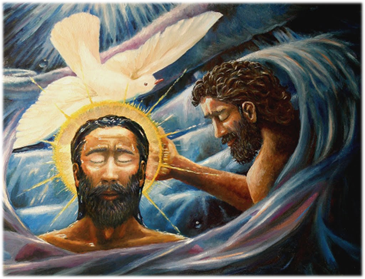
Now when all the people were baptized, and when Jesus also had been baptized and was praying, the heaven was opened, and the Holy Spirit descended upon him in bodily form like a dove. And a voice came from heaven, “You are my Son, the Beloved; with you I am well pleased.”
***
I love a good car trip. I’m just one of those people. I know some of you prefer the plane ride, but even if it’s a couple of days—unless there are other circumstances—I would rather do the car trip. I just love the movement. I love the sense of purpose and accomplishment that comes along with it. I love the changes of scenery and seeing different landscapes. And I love, especially, those rituals that sometimes go with the journey.
For example, when we go to Canada via the Thousand Island Bridge, just before we get to the border, there’s a little town in upstate New York called Mexico. And every time I see that sign, my kids know it, and they’ll groan, because I always say, “Oh no! We’ve gone the wrong way.”
Or, when heading to western New York with my wife’s family, they have all of these traditions for that familiar trip. We go through a certain town and count the number of people because it’s such a small town. And sometimes, if we’re in the mood, we’ll count the dogs too.
There’s one town where we sing Christmas carols as we go through. I’ve added a new tradition on this trip. There’s a reservoir at the top of the mountains in western Pennsylvania. There’s a big reservoir, and at the end of it, there’s one of those large concrete structures, you know, a dam. And every time I see it, I try to shock my kids by yelling, “Damn!” Then I point out the window at the dam.
I remember, too, being a child and going from central Pennsylvania to western Pennsylvania where my cousins lived, where my grandparents lived. You know, it was probably like a four-hour trip, but it seemed like forever and ever to me. And I will always remember the tunnels on the way. If you’ve been on the Pennsylvania Turnpike heading out in western PA—or heading east or west, it doesn’t matter—you’ve seen those tunnels that go under the Allegheny Mountains.
Those tunnels meant that we were almost there. The long wait was almost over.
Our passage today mentions roads quite a bit—preparing them, making them straight, making them smooth.
Now, I don’t know how relevant this is, but I did work on this in college, so you all are going to hear about it. The Romans were master road makers. Unlike our paved roads—especially this time of year, with the cold and the salt and all the potholes—theirs were made to last. The foundation of sand and rock went down several feet, and that’s why many of them are still, at least partially, in place.
We sometimes don’t think about how important the roads were to the Roman Empire. Not only for civil transportation, but they gave them a commercial advantage—the movement of goods, trading, and so forth. And also military: their military could get out and extend to various places.
The Romans had many straight and smooth roads.
Roads are an extended metaphor in scripture. Just as we use a road to get from point A to point B, spiritually, we need a way to God. How do we get to God? How do we build that road?
John gives us one answer. He says, repent and change. Turn from injustice toward justice.
He gives specific examples. If you have two coats and you come across someone who has none, give them your extra coat. If you’re a tax collector, don’t exploit your position. If you’re a soldier, don’t use your power to harass or extort people.
In other words, John is saying this is how you make the way straight. This is how you make the rough places smooth. This is how you get to God.
This is the way, John says. But then he also says, “There’s one who’s coming after me.”
And it’s interesting, the imagery that John uses for the coming of Jesus. He talks about unquenchable fire. He talks about a winnowing fork. He talks about a threshing floor. These are all pretty alarming images, right? They sound like they should evoke some fear and anxiety in us.
Have we been good enough? Are we wheat or are we chaff? Are we going to be thrown into this unquenchable fire?
But it’s really interesting when we contrast the way John foresees this with what actually happens—and the imagery that Luke uses for Jesus’ baptism. What happens?
The heavens open up. The Spirit descends on Jesus in a noticeable way, like a dove. And a voice declares, “You are my Son, the Beloved; with you, I am well pleased.”
John is like so many of us. He leads with his fear, with his anxiety. He worries that God’s coming means this kind of sharp contrast, this move to justice, where some of us will move on and others will be left behind. And we wonder, where does this wrath—this violent imagery—come from? Does it come from God? Or does it come from us?
Richard Rohr says this: “Most of us were taught that God would love us if and when we change. But in fact, God loves us so that we can change.”
What empowers change, what makes us desirous of change, is the experience of love and of being loved. It is that inherent experience of love that then becomes the engine of change.
And that turn, it seems to me, is similar to the turn in our passage. John, in telling of the coming of Jesus, uses this stark imagery, this fear-based language. But the good news turns out to be even better than he could have ever hoped.
It is not unquenchable fire. It is a dove.
It is not a threshing floor. It is a voice from heaven saying, “Beloved.”
John picks this great image—or Luke does—of this road. But maybe John got one small detail wrong. See, we all think of ourselves as building that way, as building that road. But what if it’s God?
What if it is not our job to build that road? What if it is God? What if it is not our good works or our right beliefs? What if it’s God’s love and grace that paves the way?
Another John—John’s Gospel—makes it even more explicit when he has Jesus proclaim, “I am the way.”
Frederick Buechner writes, “Jesus didn’t say any particular ethic or doctrine or religion was the way, the truth, and the life. He said that he was. He didn’t say that it was by believing or doing anything in particular that you could come to the Father. He said that it was only by him—by living, participating in, being caught up by the way of life that he embodied—that was his way.”
And here we are at the outset of Jesus’ ministry, before he could even begin doing anything, and he receives this voice saying, “You are my Beloved; with you, I am well pleased.”
The great reformer Martin Luther said this about our baptism: “Daily we dive deeper into our baptism.” What he means by this is not necessarily that we become more holy or righteous or that we stop making mistakes in our lives, or we’re suddenly perfect or treating everybody with respect and dignity. He’s saying that every day we have the chance to remember that we are loved. That the first word ever spoken over us is love. That God is pleased with us—not because of what we do or what we believe, but simply because of God’s love.
So, we’re going to do something today. We’re going to remember our own baptism.
Phoebe talked a little bit about being five and remembering her baptism. Someone else said to me—and I’ve heard this many times—”I don’t remember my baptism. I was a baby.”
It’s not necessarily about remembering the moment. It’s remembering that we are baptized. Remembering that that imprint of love has been on us, is on us. Remembering that the road, the path to God, is not one that we make to God, but one that God has made to us.
It is celebrating that love.
So during our next hymn, I invite you, if you wish, to come forward to the baptismal font and receive a remembrance of baptism. You can put your hands out this way or that way, however you’re comfortable, and I will pour water over them and ask you to remember your baptism.
And as you go back to your seat, and as you carry that reminder with you this week, I want you to also take seriously the challenge to be a remembrance of baptism in the world.
Take your own reminder and go out. And in whatever way is comfortable for you, is appropriate for you, maybe there’s someone in your life who you know is always struggling to become worthy. Or someone who’s always working and it never feels like it’s enough.
Find a way to let them know that they are loved. That they are cared for. That they are enough—not because of what they have done, but simply because God has called them “Beloved” too.
So, friends, I invite you. I invite you forward, if you wish. I invite you to remember your own baptism—whether you’ve received the sacrament or not.
Remember that God’s love has been pronounced over you. And when we leave this place, let us embody that for ourselves and let us be reminders to others as well.
Because God has already made a way. And that way is love.
Amen.


